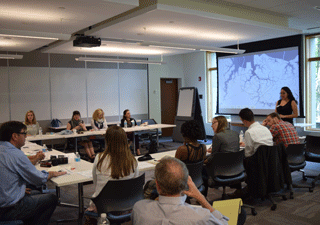
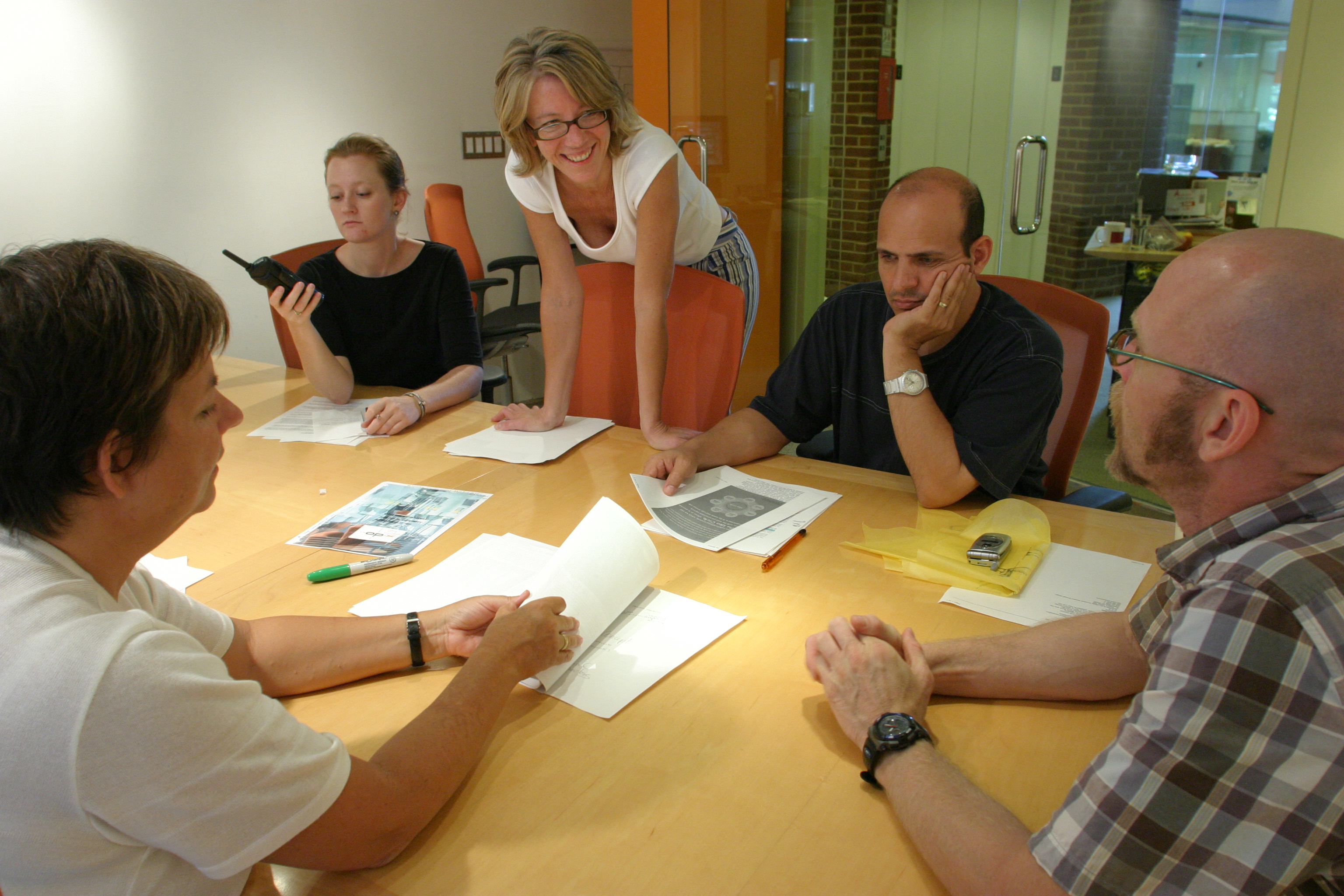
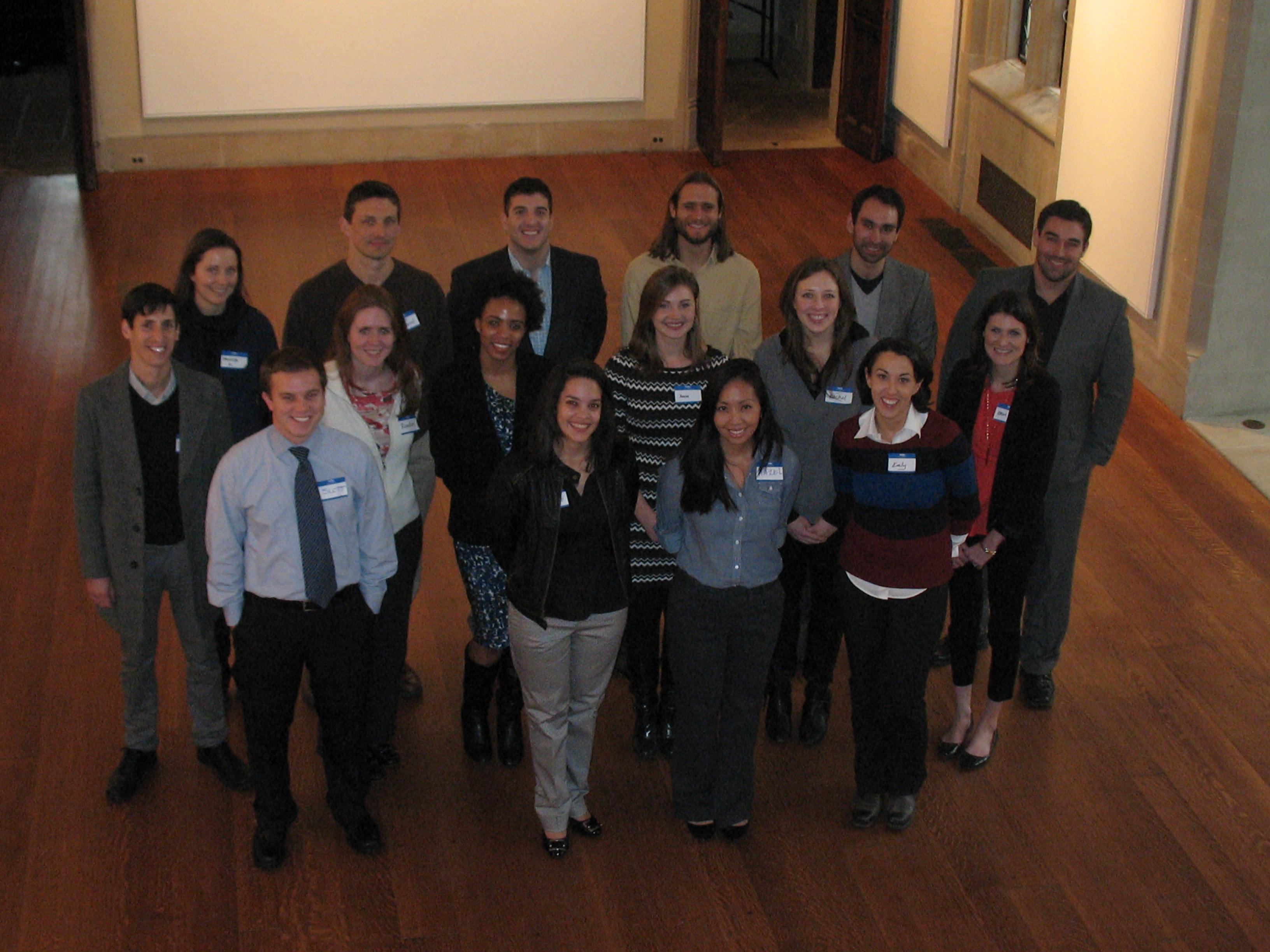
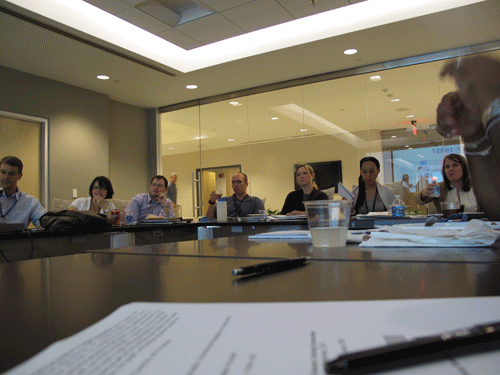
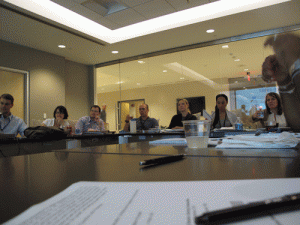
The 2015 Emerging Leaders in Architecture (ELA) class met in May where the focus was on helping the students write more persuasively and present more effectively.
Ed Crews, principal at Crews Communications, spoke to the students about some of the outlining, writing, and editing that he has seen improve his and others work over the years. He took the students through a series of writing exercises designed to help the students make their point efficiently and effectively.
photo by Marshall Dreiling
Michael Chapman from the Martin Agency reviewed some of the techniques that the agency uses to make their presentations more impactful. From his experience on being part of the teams that have made some of the most memorable commercials in recent years, he explained to the students that each presentation should be a story.
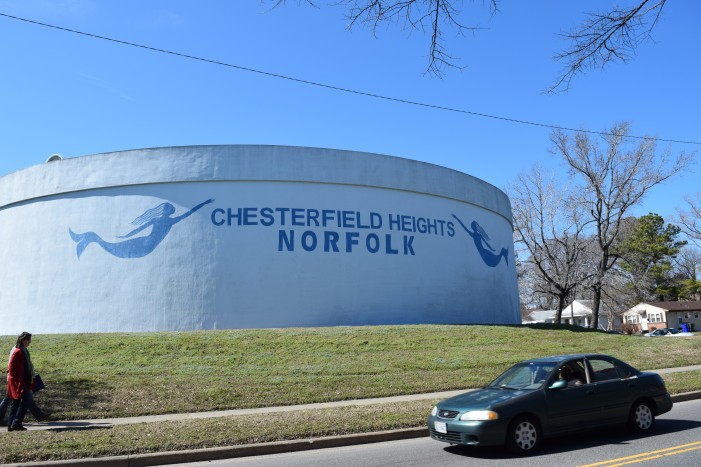
Work continues on the class project – the neighborhood of Chesterfield Heights in Norfolk. Each student individually presented their ideas of how to deal with the problem of the rising sea level in this area.
The students next session will be taking place on June 12, 2015 in Virginia Beach where they will be learning about the importance of group work dynamics.
The March ELA Session was this year’s first Project workday, and with this year’s project brief focused on the neighborhood of Chesterfield Heights in Norfolk, the students spent the day learning about the history and future of this neighborhood. Early in the day the students heard from Shereen Hughes, Mason Andrews, and Mujde Erten-Unal, from Wetlands Watch, Hampton University, and Old Dominion University respectively. With help from the Hampton and ODU students, Shereen, Mason, and Mujde presented the current research and projects about Chesterfield Heights. They spoke on how this area is being greatly affected by sea level rise, discussed some current methods for dealing with the issue, and provided concepts that the students had developed during their fall and spring semesters.
ELA Class of 2015 starts work on their project in Chesterfield Heights, Norfolk
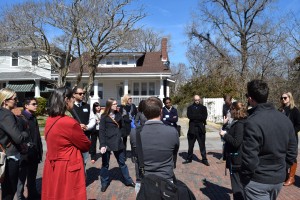
To put this new knowledge into practice, the students were treated to a tour of Chesterfield Heights. During the tour, the students were presented with the many ways that the Elizabeth River Project is educating residents and trying to bring the community together to help alleviate the pressures presented by constant flooding. Also during the tour, the students were able to visit the new Grandy Village Learning Center. During the presentation and tour of the facility given by Russell Carlock, AIA, the students learned how this LEED Gold certified building was helping to bring the community together through education and other activities on the water.
Once the students returned to the Slover Library, they met with Christine Morris, the Chief Resiliency Officer from the City of Norfolk. She spoke about how Norfolk needs to become more adaptable to various manmade and natural shocks and stresses. To point all this information in the right direction, the students used the rest of the day as a project work day.
The next session takes place on April 10th in Alexandria.
The 2015 class of the Emerging Leaders in Architecture (ELA) met on Friday, February 13 in Charlottesville. Titled “Serving Communities,” The students heard from a number of speakers about what it means to volunteer and give back to their communities.
Bruce Wardell, AIA, Kathy Galvin, AIA, and Kurt Keesecker, AIA, each used examples from their own lives where they had volunteered and what it meant to them. Knowing how busy architects lives can get, each speaker also stressed how important is is to find that aspect of volunteer work that intrigues you and that you love to do so that you get the most out of the experience. The students also visited the Greater Charlottesville chapter of Habitat for Humanity to see firsthand what giving back can do in the community.
Everything that the students participated in that day was designed to prepare them for their annual project, which begins in earnest during their meeting this month. The 2015 class project is focused on a region of Norfolk named Chesterfield Heights. This is a historic district of Norfolk that is in danger of flooding due to the rise in the sea level, and presents an interesting challenge for the students in the year ahead.
As in every year, the 2015 class is comprised of some of the best and brightest young professionals and students Virginia has to offer. Participants include one student from each of the Virginia architecture schools, one designee from each local AIA component, and seven “at-large” participants. They come from all over the Commonwealth, from firms large and small, and share the common characteristic that they have been identified as someone with potential to be a leader in the profession and the community.
2015 Class: Isabel Argoti; Taylor Clark, Assoc. AIA; Angella Dariah; Matthew Fadel, Assoc. AIA; Erika Feggestad, Assoc. AIA; Lynden Garland, AIA; Emily Hope, Assoc. AIA; Chelsea Lindsey, LEED AP BD+C; Alejandro Medina, AIA; Elizabeth Morgan, Assoc. AIA; Kristin Moye, Assoc. AIA; Vanessa Reisin, Assoc. AIA; John Salmons; Lauren Shumate; Emily Striffler, Assoc. AIA; Daniel Whitmire, Assoc. AIA.
The ELA program begin in 2009 and now has over 70 alumni — many of which have assumed leadership positions in their firms and AIA components. Currently there is an ELA alum or current participant on the board of every AIA component in Virginia.
The Virginia Society AIA announces a call for applications for the 2015 class of Emerging Leaders in Architecture: An Honors Academy of the Virginia Society AIA (ELA).
ELA is an intensive program of educational sessions structured around presentations, discussions, team exploration, analysis, consensus-building, collaboration, and case study activities undertaken over the course of a year by a small cadre of participants selected for their [adrotate banner=”61″]potential to be outstanding contributors to the profession and the community. Facilitators and mentors who are established leaders in the building, finance, non-profit, development, university, legal, consulting, and design professions and in the community at large develop and deliver the sessions, designed to provide participants with advanced knowledge and skills related to specific areas of leadership and practice.
The program consists of seven day-long seminars, several work sessions, culminating with a presentation at Architecture Exchange East. The application is available here. The seminars are interactive, drawing on real examples and actively involving participants. They rotate among sites in Roanoke, Charlottesville, Richmond, Alexandria and Norfolk in conjunction with the firms, schools, and the local AIA component in each area.
How to Apply
The committee seeks applicants from three categories:
Component Nominees Each of the five Virginia AIA local component Boards may nominate one or more individuals for admission to the program. One participant will be selected from each chapter for a total of five.
Student Nominees Each Virginia Architecture School (UVa, VT, Hampton, and WAAC) may nominate one or more students for admission to the program. One participant will be selected from each school for a total of four.
Open Applications Applicants may apply on their own or be nominated by someone else. Seven participants will be selected from among these applicants.
The Society’s award-winning Emerging Leaders in Architecture (ELA) program was developed to jump-start the careers of young professionals. Conceived of and lead by a passionate steering committee of successful architects, the program was designed to share the things they wished they had learned in architecture school.
Each of the seven day-long-sessions focus on developing essential skills like financial management, communication and negotiation, advocacy and public service, and much more.
Want to be a member of this elite group of leaders?Apply to be a member of the ELA class of 2015. Contact Rhea George for more information on how to nominate an emerging leader or with questions about the program.
We were curious about these leaders, so we asked members of the ELA class of 2014 the same five questions, and this is what they had to say.
Jason Albers, AIA
Jason Albers, AIA
Q: What building evoked a strong reaction from you recently—either positive or negative?
A: I went to New York last summer, and while it wasn’t quite finished, One World Trade Center seemed like a missed opportunity. The design wasn’t very exciting or dramatic, overall pretty tame actually. It could have been much more than a really tall glass box. Though, I also visited the memorial grounds and that was a very solemn and powerful experience.
Q: What is the last book you read?
A: A Tale of Two Cities, by Charles Dickens. A while back, I thought it would be a good idea to try and read some of the classics of literature, at least one per year.
Q: How did you discover your passion for architecture?
A: That discovery has been a continuous, gradual process over the years, and is ongoing. I first became interested in architecture when, in high school, my family was moving to a new house and I enjoyed looking through the sample floor plans and imagining the space in my head. But now, after moving to the dense urban D.C.-area, I have really come to love the challenges of designing within tight urban infill sites while contributing to the downtown experience.
Q: What is your favorite thing to do to relax?
A: This is going to sound strange, but playing soccer. While it can be strenuous, exhausting, exciting and frustrating at times, I can become completely absorbed into the game and forget about everything else in the world. I love the game so much and have been playing for so long that I can rely solely on my instincts, turn my mind off for 90 minutes and just enjoy myself.
Q: What advice do you have for aspiring architects?
A: The best architects are the ones that find a good balance between showing confidence and humility, between being opinionated and deferential. Much of practicing architecture is working with people, be it clients, consultants, contractors and coworkers, so being approachable and collaborative is important. Though it’s also critical to be able to stand up for what you believe in, and know when the time is right to do that.
Alicia Canady
Alicia Canady
Q: What building evoked a strong reaction from you recently—either positive or negative?
A: The Chicago Tribune building in Chicago recently caused a strong reaction of admiration. I love Neo-Gothic architecture when it comes to studying older architectural styles. It was impressive to see this building still standing and dominating the city block while next to buildings like the Trump Tower.
Q: What is the last book you read?
A: The last book I read was They Tell Me of a Home by Daniel Black.
Q: How did you discover your passion for architecture?
A: I discovered my passion for architecture during my junior year of high school when I realized I loved art and math. I had watched my father design and build our basement. It made me want to be able to create spaces that help improve people’s lives through very strong artistic qualities.
Q: What is your favorite thing to do to relax?
A: My favorite thing to do to relax is split equally between about four different things. I either play video games, watch movies or shows, drive without a destination, or listen to music.
Q: What advice do you have for aspiring architects?
A: I would advise aspiring architects to always stay true to their style of design and learn to handle constructive criticism to make yourself better. I would also suggest to be open to any advice from your peers and mentors. Most importantly, just love what you do no matter how hard it gets.
Alex Helms
Alex Helms
Q: What building evoked a strong reaction from you recently—either positive or negative?
Q: How did you discover your passion for architecture?
A: As a kid, my tools for building were tape, cardboard and Lego. Ever since then, I’ve always had a passion for learning how things went together and architecture allowed me to pursue that passion at various scales (master planning to wall assemblies).
Q: What is your favorite thing to do to relax?
A: Woodworking and building furniture
Q: What advice do you have for aspiring architects?
A: Passion trumps talent. Skills utilizing architecture tools develop over time and with practice; talent uses those tools to design creativity. Passion for architecture allows you to love what you do and not give up through the coming struggles.
Emily F. Hogan, Assoc. AIA
Emily F. Hogan, Assoc. AIA
Q: What building evoked a strong reaction from you recently—either positive or negative?
A: I visited Graceland last summer. It was simultaneously both.
Q: What is the last book you read?
A: The Kaplan ARE study guide. Before that:Lean In by Sheryl Sandburg. The latter was a brilliant, inspiring must-read that I can’t recommend highly enough; the former—not so much.
Q: How did you discover your passion for architecture?
A: I always had an interest in design and making, and that initially led me to pursue a degree in interior design. Early in my undergraduate studies, however, I realized my interests aligned more closely with the field of architecture. Once I got to architecture school a few years later I was hooked.
Q: What is your favorite thing to do to relax?
A: Spend time in the back yard with my husband, dog, a magazine, and the grill.
Q: What advice do you have for aspiring architects?
A: If you’re considering becoming an architect, make sure you’re 100% committed. This profession requires intensity and passion. It’s not for the half-hearted.
Evan MacKenzie, Assoc. AIA
Evan MacKenzie, Assoc. AIA
Q: What building evoked a strong reaction from you recently—either positive or negative?
A: I had the opportunity to enjoy an evening picnic with some friends from Spatial Affairs Bureau on a farm outside of Gordonsville where they designed and helped build a series of pavilions. They curated a beautiful experience — smells of cedar and fresh rain, the flickering of fireflies, croaking frogs, laughter and beer — and the sense that we were meant to be there.
Q: What is the last book you read?
A: I’m in the middle of several books, but over the last couple of years nobody has made me think more than The Atlantic’s Ta-Nehisi Coates. His blog posts and articles are human and illuminating and important, and it’s been enthralling to see his thoughts and ideas evolve in the blog format as part of a conversation with his readers.
Q: How did you discover your passion for architecture?
A: Honestly every day is a struggle to find it — my passion is for people and ideas, and at its best architecture provides an avenue for engaging that passion in a very real way.
Q: What is your favorite thing to do to relax?
A: Sit on a rock in the James River.
Q: What advice do you have for aspiring architects?
A: 1. We’re all in this together.
2. Get some sleep.
3. Draw every day.
Lauren A. Nelson
Lauren A. Nelson
Q: What building evoked a strong reaction from you recently—either positive or negative?
A: Studying this summer in Rome, I am inspired by the history and the layering of new and old in the buildings. I am also impressed by the piazza archetype as a successful model for urban public space.
Q: What is the last book you read?
A: The Defining Decade by Meg Jay. I am also reading articles for independent research on the effects of daylighting on design and health.
Q: How did you discover your passion for architecture?
A: I first discovered that architecture might be for me when I attended an AIA Shadow Day in high school in the Hampton Roads area. I then applied to architecture schools for college, and my passion really developed through the process of learning, thinking, drawing, and making.
Q: What is your favorite thing to do to relax?
A: Figure Skating, Sketching, and Painting
Q: What advice do you have for aspiring architects?
A: Develop your interests and passions for architecture by seeking out opportunities and by learning as much as you can. Be inspired to ask new questions and to push the boundaries of the discipline. Remember, architecture is just as much a process as it is a product, so allow yourself the opportunity to make new discoveries along the way.
Kylan Shirley, Assoc. AIA
Kylan Shirley, AIA
Q: What building evoked a strong reaction from you recently—either positive or negative?
Q: How did you discover your passion for architecture?
A: My father is an architect and I knew as soon as I got my hands on a lead holder and a scale
Q: What is your favorite thing to do to relax?
A: Ride a bike
Q: What advice do you have for aspiring architects?
A: Learn about everything.
Nicholas R. Valadez, Assoc. AIA
Nicholas R. Valadez, Assoc. AIA
Q: What building evoked a strong reaction from you recently—either positive or negative?
A: Villa Müller by Adolf Loos. The intertwining spaces in this house seem composed as it were were the program for its inhabitants’ lives. Informing their actions rather than responding to them.
Q: What is the last book you read?
A: I’m currently reading Shogun by James Clavell. A fictional account of the West’s early encounters with feudal Japan.
Q: How did you discover your passion for architecture?
A: Although I had a strong interest in architecture, I did not discover my passion for it until I was in college. Eero Saarinen’s MIT Chapel taught me that buildings could be more than the sum of their parts.
Q: What is your favorite thing to do to relax?
A: I spend time outdoors. Hiking, cycling, and even yard work. I’m happy as long as I get some fresh air.
Q: What advice do you have for aspiring architects?
A: Try to understand how building elements work and why designs are successful. More importantly, ask questions, be curious, and never forget to be patient. It’s easy to know good work when you see it but significantly more difficult to create it. View your work with the same eyes you view others’.
Tyler Whitney
Tyler Whitney
Q: What building evoked a strong reaction from you recently—either positive or negative?
A: Calatrava’s new PATH station near the World Trade Center – you cannot step into that space without feeling awestruck
Q: What is the last book you read?
A: How Music Works by David Byrne
Q: How did you discover your passion for architecture?
A: In high school the new building was being built around our trailer units and I found myself looking out the window for whole class periods. Watching workers sculpt the earth and erect buildings out of that void sparked my interest in design. We moved into the new building and I had an appreciation for the thought and the work that went into the design and construction. Luckily they still had to build the stadium – I got to keep watching.
Q: What is your favorite thing to do to relax?
A: Turning on some tunes, grilling some food, and tossing some Frisbee.
Q: What advice do you have for aspiring architects?
A: Go out and draw. Explore the world around you and take in as much as you can.
Rachel I. Williams-Clark, Assoc. AIA
Q: What building evoked a strong reaction from you recently—either positive or negative?
A: Everything Gaudi did in Barcelona. I had always loved his work from afar, but when I finally got to see it in person I loved it even more. Whether a park or building, his work is always captivating.
Q: What is the last book you read?
A: The Psychopath Test (Jon Ronson) – I like to mix it up. A Walk in the Woods (Bill Bryson) – about hiking the Appalachian Trail.
Q: How did you discover your passion for architecture?
A: I grew up in a family of artists and always had a natural inclination towards the arts, but I also did well in math and science. By the time I got to college I realized I wanted to study a more “structured” art (I loved the precision of drafting). The University of Georgia didn’t have an architecture program so I studied interior design. However, I realized architecture was really what I wanted to do my junior year because I was always frustrated that my class projects never allowed me to explore the site or building exteriors. So, I finished up my undergrad degree and enrolled at Virginia Tech to get my masters in architecture.
Q: What is your favorite thing to do to relax?
A: Running. Sleeping. Sitting down with a nice IPA!
Q: What advice do you have for aspiring architects?
A: Diversify – become a jack of all trades and you’ll always be busy.
The deadline for applications to become a member of the 2014 class of the Emerging Leaders in Architecture has been extended to Nov. 22, 2013. The intensive, year-long program is intended to provide the tools and experiences that emerging architects need to jumpstart their careers.
Accelerate your professional growth, advance your career, and serve society as a leader in the community.
Examine the evolving roles of architects and firms
Gain the resources to make informed business decisions about financial and practice management matters
Consider the fundamental legal, ethical and societal responsibilities of architects
Develop a peer network to serve as an ongoing resource
Learn from established leaders in the building, finance, non-profit, development, university, legal, consulting, and design professions. Each of the seven day-long sessions focuses on essential strategies or skills such as financial management, presentation and communication skills, negotiating techniques, understanding legal and ethical issues, and public service. Put the concepts you learn into practice and enhance your leadership skills with a class project solving a real-world problem.
The committee seeks applicants from three categories:
Component Nominees Each of the five Virginia AIA local component Boards may nominate one or more individuals for admission to the program. One participant will be selected from each chapter for a total of five.
Student Nominees Each Virginia Architecture School (UVa, VT, Hampton, and WAAC) may nominate one or more students for admission to the program. One participant will be selected from each school for a total of four.
Open Applications Applicants may apply on their own or be nominated by someone else. Seven participants will be selected from among these applicants.
The Virginia Society AIA is accepting nominations for the 2014 class of the Emerging Leaders in Architecture through Nov. 15, 2013. The intensive, year-long program is intended to provide the tools and experiences that emerging architects need to jumpstart their careers.
“I have been enlightened to the full potential of an architect in business and as part of a community.”
-Program Participant
Accelerate your professional growth, advance your career, and serve society as a leader in the community.
Examine the evolving roles of architects and firms
Gain the resources to make informed business decisions about financial and practice management matters
Consider the fundamental legal, ethical and societal responsibilities of architects
Develop a peer network to serve as an ongoing resource
Learn from established leaders in the building, finance, non-profit, development, university, legal, consulting, and design professions. Each of the seven day-long sessions focuses on essential strategies or skills such as financial management, presentation and communication skills, negotiating techniques, understanding legal and ethical issues, and public service. Put the concepts you learn into practice and enhance your leadership skills with a class project solving a real-world problem.
The committee seeks applicants from three categories:
Component Nominees Each of the five Virginia AIA local component Boards may nominate one or more individuals for admission to the program. One participant will be selected from each chapter for a total of five.
Student Nominees Each Virginia Architecture School (UVa, VT, Hampton, and WAAC) may nominate one or more students for admission to the program. One participant will be selected from each school for a total of four.
Open Applications Applicants may apply on their own or be nominated by someone else. Seven participants will be selected from among these applicants.
The Society’s award-winning Emerging Leaders in Architecture (ELA) program was developed to jump-start the careers of young professionals. Conceived of and lead by a passionate steering committee of successful architects, the program was designed to share the things they wished they had learned in architecture school.
Each of the seven day-long-sessions focus on developing essential skills like financial management, communication and negotiation, advocacy and public service, and much more.
Want to be a member of this elite group of leaders? Contact Wayne Conners to find how to apply for the 2014 class.
We were curious about them, so we asked members of the ELA class of 2013 the same five questions, and this is what they had to say.
Anna Elizabeth Lockwood, Assoc. AIA
Anna Elizabeth Lockwood, Assoc. AIA
Q: What building evoked a strong reaction from you recently—either positive or negative?
A: The Monticello Hotel in Norfolk, or rather, an old photo that I saw recently that was taken during its demolition. It reinforced my belief that there is a place for the old amongst the new, and that while it is important for cities to continue to build and grow, we must be thoughtful in guiding the direction of our progress in order to preserve the souls of the places that we build upon.
Q: What is the last book you read?
A: I’m in the middle of studying for the ARE, so anything else that I pick up tends to be easy and entertaining. Right now, between reading chapters on Structures, I’m reading The Sookie Stackhouse Novels by Charlaine Harris; they are goofy and charming.
Q: How did you discover your passion for architecture?
A: I discovered my passion for architecture when I realized that it was the meeting place of reason and intuition; a melding of mathematics and art. As a child, I loved art and would entertain myself completely by drawing for hours on end. As I grew older, I discovered my love for mathematics. Practicing architecture gives me opportunities to find the balance between both passions.
Q: What is your favorite thing to do to relax?
A: Running, hiking, camping, going to the beach, disc golf — I find basically any outdoor activity to be extremely relaxing.
Q: What advice do you have for aspiring architects?
A: Be versatile and work hard. Learn that there is so much to learn that you will never run out of opportunities to grow.
Scott Campbell, AIA
Scott Campbell, AIA
Q: What building evoked a strong reaction from you recently—either positive or negative?
A: The Taubman Museum of Art by Randall Stout evoked mixed reactions. While the ‘Gehryesque’ exterior forms are not my cup of tea, the interior spaces are quite striking.
Q: What is the last book you read?
A: “The Alchemist” by Paulo Coehlo
Q: How did you discover your passion for architecture?
A: I’ve always had a deep interest in architecture, but my real passion for it emerged when I did several studios in Chicago while in architecture school. The volume and quality of architecture in Chicago is inspiring.
Q: What is your favorite thing to do to relax?
A: Have a cold beer while reading a book on the beach.
Q: What advice do you have for aspiring architects?
A: Ask questions. Learning from others in the profession is an invaluable resource.
Carmine Aniello Cafiero, Assoc. AIA
Carmine Aniello Cafiero, Assoc. AIA
Q: What building evoked a strong reaction from you recently—either positive or negative?
A: Tom Kundig’s The Brain. Kundig shows a masterful use of materiality with an elegantly simple and deliberate approach to space making.
Q: What is the last book you read?
A: Non-Fiction: “The Poisoner’s Handbook: Murder and the Birth of Forensic Medicine in Jazz Age New York” by Deborah Blum
Fiction: “The Camel Club” by David Baldacci
Q: How did you discover your passion for architecture?
A: My great-uncle was one of the architectural illustrators for the World Trade Center complex in ’73. He had copies of the renderings, in addition to plans, sketches, and other drawings of the projects he was working on, in his office and I would just get lost in them when we visited.
Q: What is your favorite thing to do to relax?
A: Watching predictable crime dramas on TV with my wife Stacey and exercise – not at the same time
Q: What advice do you have for aspiring architects?
A: 5 quotes:
“Talent is God-Given. Be Humble. Fame is man-given. Be grateful. Conceit is self-given. Be careful.” -John Wooden
“Don’t go around saying the world owes you a living. The world owes you nothing; it was here first.” -Mark Twain
“Unless someone like you cares a whole awful lot, nothing is going to get better. It’s not.” -Dr. Seuss
“To be yourself in a world that is constantly trying to make you something else is the greatest achievement.”-Ralph Waldo Emerson
“The three great essentials to achieve anything worthwhile are: hard work, stick-to-it-iveness, and common sense.” -Thomas Alva Edison
Nicholas Knodt
Nick Knodt
Q: What building evoked a strong reaction from you recently—either positive or negative?
A: Most recently, the Paris Opera House struck me with its fantastic networks of pathways interwoven with its highly complex program.
Q: What is the last book you read?
A: “The Seduction of Place” by Joseph Rykwert.
Q: How did you discover your passion for architecture?
A: I discovered my passion for architecture while growing up in the suburbs of Washington, D.C., wishing to help design the next generation of suburban communities.
Q: What is your favorite thing to do to relax?
A: Get lost in a city.
Q: What advice do you have for aspiring architects?
A: Find an architect with a body of work that inspires you and thoroughly study their design process and built work.
Erin Webb, Assoc. AIA
Erin Webb, Assoc. AIA
Q: What building evoked a strong reaction from you recently—either positive or negative?
A: Thorncrown Chapel by Fay Jones
Q: What is the last book you read?
A: “The Great Gatsby” (again)
Q: How did you discover your passion for architecture?
A: Slowly and over time. I can’t say that I knew I would be an architect when I was little, although I did ensure that Barbie always had nice digs. Art was always an interest of mine and it gradually morphed into art in the built environment.
Q: What is your favorite thing to do to relax?
A: Singing (in my car) or spending time with my pug, Dottie
Q: What advice do you have for aspiring architects?
A: Work hard, ask questions, be observant, and have fun with design.
Brad Lockwood, Assoc. AIA
Brad Lockwood, Assoc. AIA
Q: What building evoked a strong reaction from you recently—either positive or negative?
A: Fondation Beyeler by Renzo Piano. I really enjoy how he composed the building around the primary idea of expressing a piece of art, Monet’s lily pad, through his architecture.
Q: What is the last book you read?
A: “The Road” by Cormac MacCarthy and Kaplan ARE 4.0 study guides.
Q: How did you discover your passion for architecture?
A: I love art and I love putting things together, so it was a natural fit.
Q: What is your favorite thing to do to relax?
A: When I’m not working or spending time with my beautiful wife, Anna, you can find me under my Jeep Comanche with a wrench or on the beach with my yellow lab, Troeg.
Q: What advice do you have for aspiring architects?
A: Find a mentor. Not every architect is worth emulating, but there are a lot of great folks out there that are and they are often times willing to take young architects under their wing. Mentors will help you tremendously in your development by allowing you both opportunities to succeed as well as opportunities to make mistakes. I have had been blessed with unbelievable mentors in my career so far.
Hazel M. Eclarinal-Lai, Assoc. AIA
Hazel M. Eclarinal-Lai, Assoc. AIA
Q: What building evoked a strong reaction from you recently—either positive or negative?
A: Not necessarily a strong reaction; but wherever I travel, all airports are looking the same.
Q: What is the last book you read?
A: “Quiet: The Power of Introverts in a World That Can’t Stop Talking” by Susan Cain
Q: How did you discover your passion for architecture?
A: By the age of 8, I was drafting floor plans of my dream house.
Q: What is your favorite thing to do to relax?
A: Not too healthy or intellectual, but I enjoy a marathon of a great TV show — not reality ones.
Q: What advice do you have for aspiring architects?
A: Brace yourself for a lifetime commitment.
Camila Paggi
Camila Paggi
Q: What building evoked a strong reaction from you recently—either positive or negative?
A: The Richland County Public Library in Columbia, SC. I would just say, you have to visit and sit inside for a few minutes to experience the calm, peaceful, and a beautiful mixture of nature and architecture.
Q: What is the last book you read?
A: “The Kite Runner,” which I would recommend to everyone. Khaled Hosseini’s writing is inspiring.
Q: How did you discover your passion for architecture?
A: My family is from El Salvador, a third world country, so at a young age I knew that I wanted to help those who were living in poverty and create something good for them. I think design should be accessible to everyone.
Q: What is your favorite thing to do to relax?
A: Playing piano, by far, is one of the only things that truly relaxes me. I can play as aggressively as I want and express every ounce of stress or frustration I am going through. Finally when I am calm, I like to end with a piece like the Moonlight Sonata and all the stress just melts away.
Q: What advice do you have for aspiring architects?
A: As an aspiring architect myself, I think the best advice I could give is to draw every day. It was a piece of advice given to me freshman year in undergrad and I could not agree more.
Raedun de Alba, Assoc. AIA
Raedun de Alba
Q: What building evoked a strong reaction from you recently—either positive or negative?
A: The Thomas Jefferson Middle School and Community Center. While it’s not an architectural marvel, it is simultaneously a school, a theater, a gym, a community center, a church, and much more.
Q: What is the last book you read?
A: “The Brief Wondrous Life of Oscar Wao” by Junot Díaz
Q: How did you discover your passion for architecture?
A: In sixth grade while making a 3-dimensional paper house.
Q: What is your favorite thing to do to relax?
A: A bike ride on the Mount Vernon Trail.
Q: What advice do you have for aspiring architects?
A: Sketch. Draw. Doodle. And explore the world around you.
Carl Schwarz, AIA
Carl Schwarz, AIA
Q: What building evoked a strong reaction from you recently—either positive or negative?
A: My fixer-upper house: As insignificant and run-down as it may be, it’s where I use my own hands to experiment with architecture, it’s a source of pride, and nothing makes me feel more at ease than home.
Q: What is the last book you read?
A: “Keeping Chickens” by Jeremy Hobson and Celia Lewis
Q: How did you discover your passion for architecture?
A: I honestly can’t remember. Some of my earliest memories are of creating imaginary places, whether on paper, in the sand, or with whatever scraps I could find.
Q: What is your favorite thing to do to relax?
A: Work in my garden – my overgrown adult sandbox.
Q: What advice do you have for aspiring architects?
A: Maintain all your interests and passions — architecture can be whatever you want to make of it, but it helps to leave all your doors open.
Brooke Emlen Karius, AIA
Brooke Emlen Kariu, AIA
Q: What building evoked a strong reaction from you recently—either positive or negative?
A: Museum of Contemporary Art in Denver. I used to go there weekly, the building reacts so well with the street and the light. I love the transition from the sidewalk into the museum.
Q: What is the last book you read?
A: “Blue Highways”
Q: How did you discover your passion for architecture?
A: My dad is an architect. I never much consider another profession. I was always drawn to art, physics, and math. There aren’t many other opportunities to combine all of those interests.
Q: What is your favorite thing to do to relax?
A: Being from Colorado I am all mountains, I love to get outside. Biking, hiking, running, yoga, and I have just started rock climbing.
Q: What advice do you have for aspiring architects?
A: I wish I had double majored in business, so learn the business side of architecture early. Get experience on as many different types of projects as you can. And there will always be another deadline, make your well being a priority.
Christina K. Laney
Christina K. Laney
Q: What building evoked a strong reaction from you recently—either positive or negative?
A: Most recently, I was positively impacted by the design of the America’s Center Convention Complex in St. Louis, MO (my hometown). My prom was held here, but I am just now appreciating the facade!
Q: What is the last book you read?
A: I am currently reading “Successful Women Think Differently” by Valorie Burton. It is an interactive read, and shares the viewpoints of many inspirational leaders.
Q: How did you discover your passion for architecture?
A: My classmates and I visited the architecture firm of a fellow student’s dad in elementary school. I loved the creativity, the technology and how chic everyone looked.
Q: What is your favorite thing to do to relax?
A: I love dancing and talking to myself when I need to calm down. (…only child problems.)
Q: What advice do you have for aspiring architects?
A: I encourage all aspiring architects to vigorously read and write! Though our field is based in imagery, innovative articles, tutorials, thesis projects and even specification documents rely on communicating through writing and comprehension.
The AIA Board of Directors Class of 2013 chose as its name The Original 13 based on Richard Upjohn and the 13 Architects who founded the AIA in 1857. They took their class name from the tradition of the past but are looking to the future.
They want to meet Emerging Leaders at the AIA Convention this June in Denver, and are offering five fellowships in the amount of $1,000 each to attend the Convention, expand career horizons and look to the future.
HOW IT WORKS
Send a Tweet of Interest to share what you hope to learn by attending the Convention as an Emerging Leader. The Class will review your Tweets and select ten finalists. These finalists will write a more detailed narrative of their aspirations. Five Fellowship Recipients will be selected from this group on the basis of their narratives.
Each Fellowship Recipient will be paired with two Class of 2013 Board Directors during the Convention and will receive a $1,000 stipend to offset expenses. They’ll help each Fellowship Recipient realize his/her aspirations at Convention; get to know them personally with the hope of forming enduring relationships. After Convention they’ll ask for a report on the experience to share with other Emerging Leaders.
AIA CONVENTION IN DENVER
June 20-22, 2013
Denver, Colorado
FELLOWSHIP FOR EMERGING LEADERS
Students
Associates
Young Architects
TWEET OF INTEREST
Tweet us at #2013FEL
Tweet period is open until MARCH 30TH
Finalists will be notified via phone by APRIL 12TH