The AIA Virginia Prize is a design charrette that engages students at all of the architecture programs in Virginia. Conducted simultaneously at each institution, students are given the competition program Friday at 5 p.m. They work over the weekend to create a board presenting their design solution by 9 a.m. the following Monday. The competition is intended to promote collaboration between the profession, students and professors in Virginia.
The first round of submissions is juried at the university level and up to 10 finalists from each school will be sent to be juried at the state level.
The 2026 competition takes place over the January 30 weekend. Faculty at James Madison University are finalizing the brief. The challenge brief will be posted to this page at 5 p.m. on Friday, January 30 and submissions are due to the school at 9 a.m. on Monday, February 2.
If you would like to make a donation to the AIA Virginia Prize, please click here. All donations are tax-deductible.
We wish the participating students a pleasant outing and look forward to considering and celebrating their proposals.
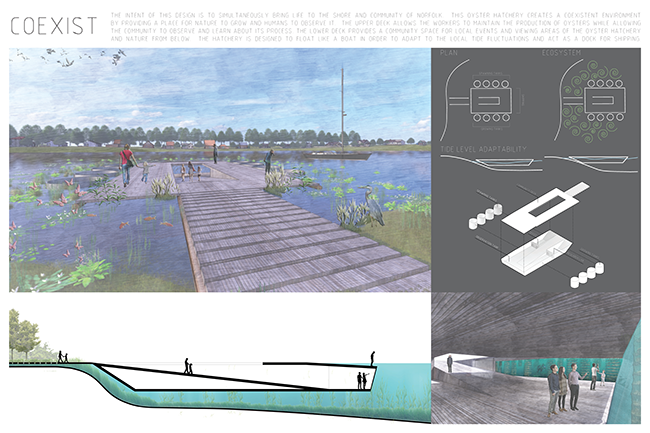
AIA Virginia Prize The top award and $2,250 prize goes to Kyle Quinn, a student at the Washington-Alexandria Architecture Center, for the submission “Coexist.” The jury called it “a standout, singular idea that made you consider the challenge in an entirely new way … It was completely different from all the others in the way it engaged the waterfront.”
“Coexist” by Kyle Quinn
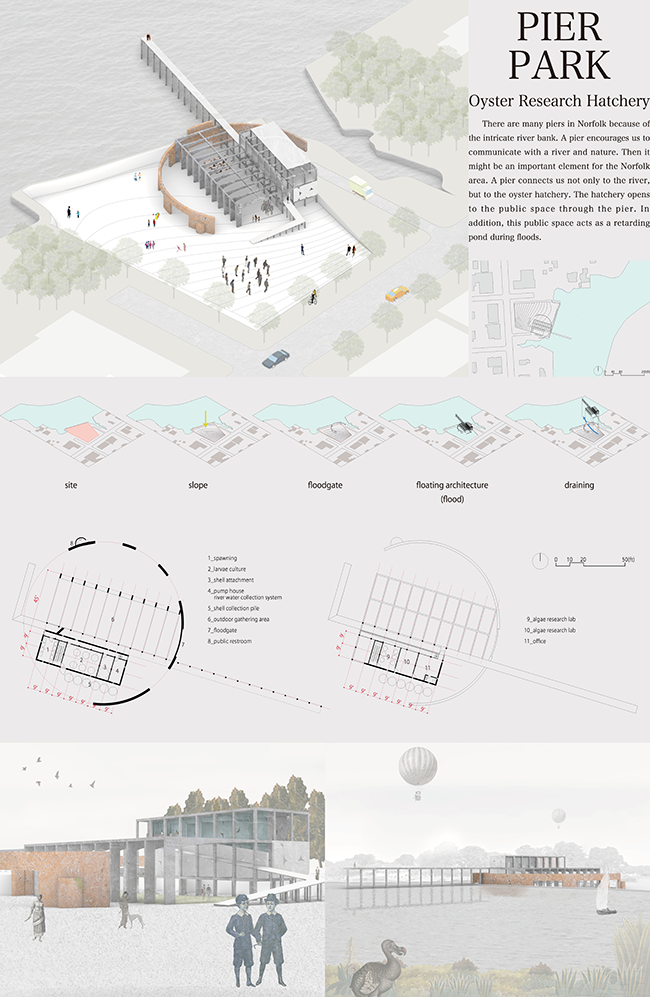
Special Jury Citation A special jury citation goes to Shunsuke Araki for “Pier Park” from the Washington-Alexandria Architecture Center. The jury appreciated the use the river vernacular as well as the deployment of the barrier and floating components to address flooding. The jury also noted the diagrams, calling them “incredibly strong.”
“Pier Park” by Shunsuke Araki from WAAC
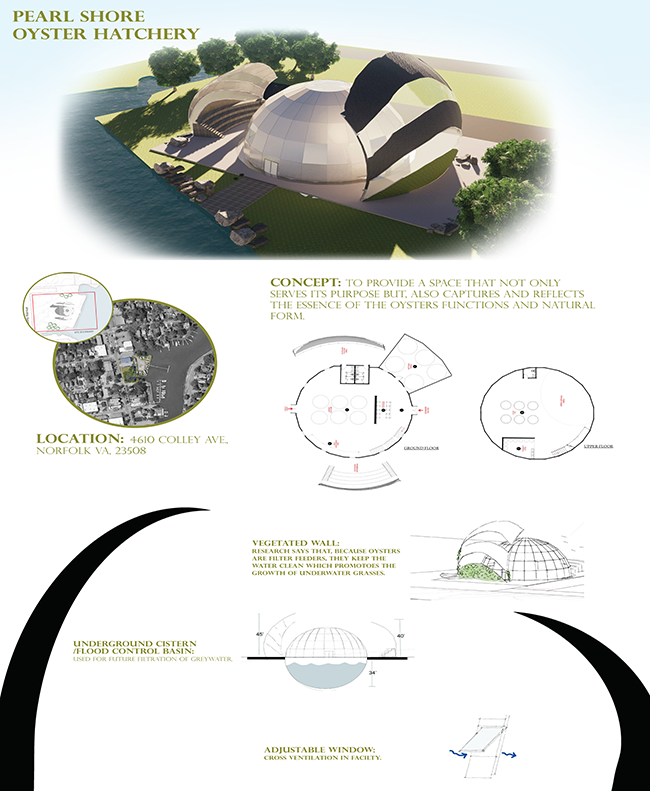
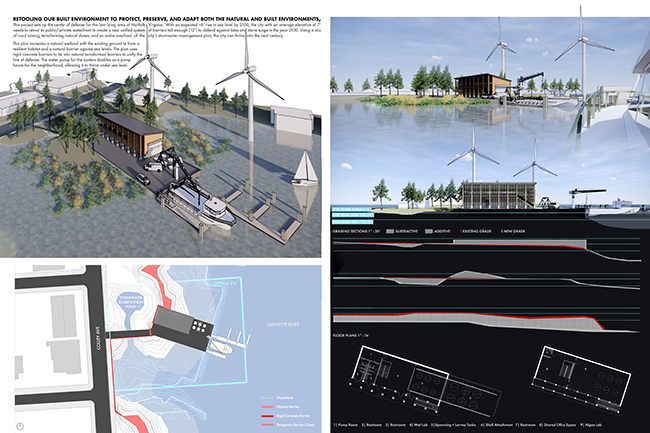
Hampton University Best of School Best of School Award for Hampton University and $250 goes to Rachel Collins for “Pearl Shore Oyster Hatchery.” The jury noted that the “aspirational” concept displayed some “sophisticated thinking.”
“Pearl Shore Oyster Hatchery” by Rachel Collins from Hampton University
University of
Virginia Best of School
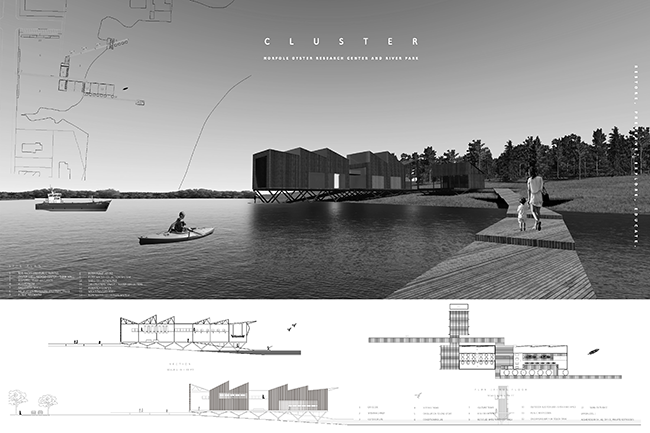
The Best of School Award for University of Virginia and $250 goes to Kelsey
Smith for “Cluster.” The jury appreciated that visitors could make a waterborne
approach to the site and the park-like setting. “I loved the restraint that was
used here,” said one juror.
“Cluster” by Kelsey Smith from UVA
Virginia Tech Best of
School
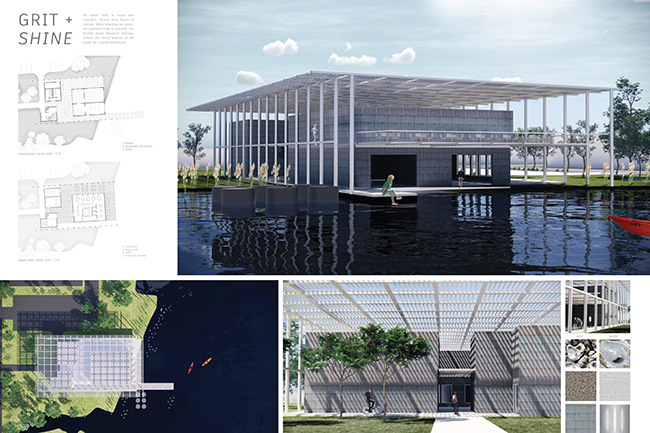
The Best of School Award for Virginia Tech and $250 goes to Laurie Booth for “Grit
and Shine.” The jury called it “extremely well presented … probably the
strongest graphic presentation we received. It really commands the site.” They
also appreciated the business component on the terrace and the references to
oysters in the materials selection.
“Grit and Shine” by Laurie Booth from Virginia Tech
The following were
recognized with an Honorable Mention
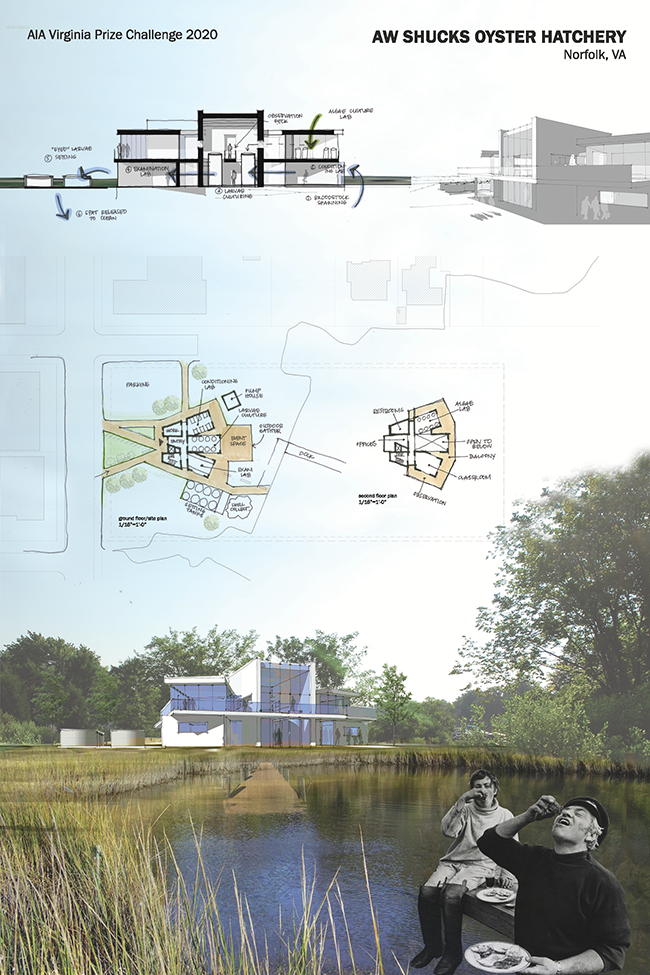
“Aw Shucks Oyster Hatchery” by Emily Broadwell from the Washington-Alexandria Architecture Center
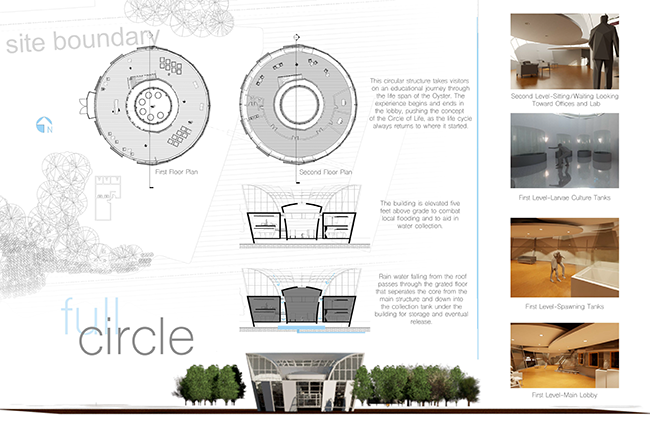
“Full Circle” by Paris Casey from Hampton University
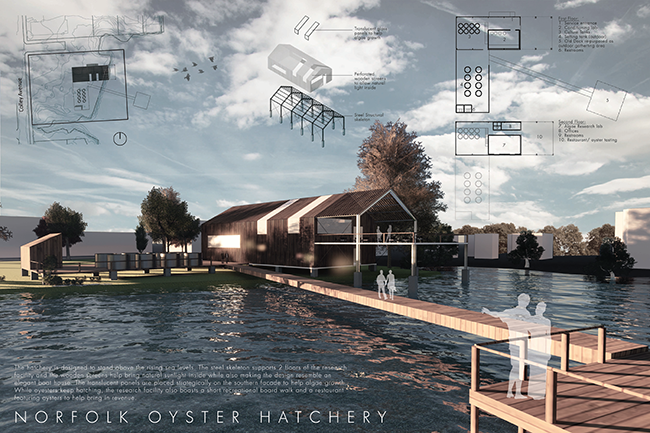
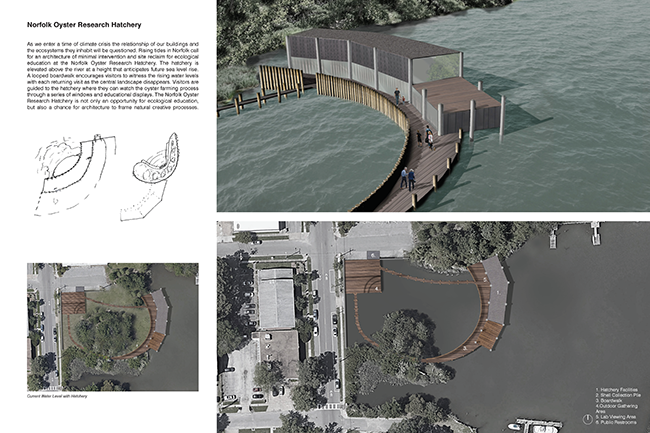
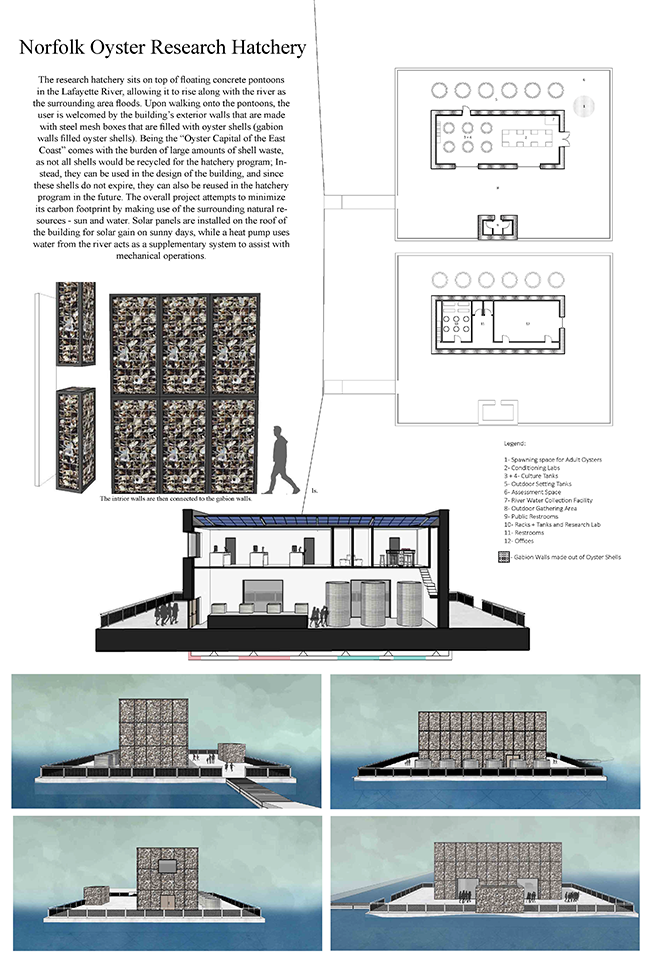
“Norfolk Oyster Research Hatchery” by Vidusha Sridhar from Virginia Tech
“Norfolk Oyster Research Hatchery” by Alex Boardwine from Virginia Tech
“Norfolk Oyster Research Hatchery” by Randa Malkawi from the Washington-Alexandria Architecture Center
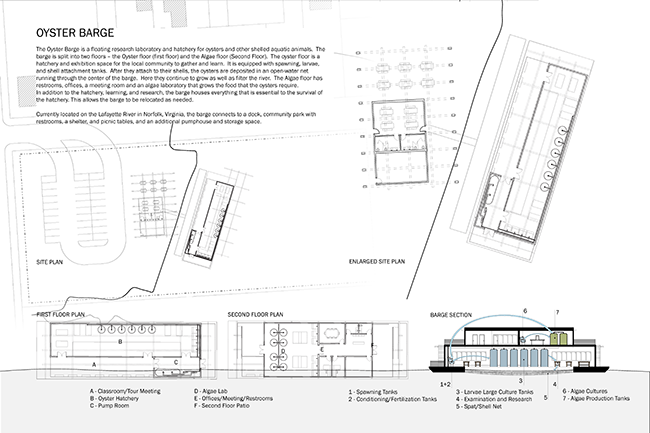
“Oyster Barge” by Luke Rumage from the Washington-Alexandria Architecture Center
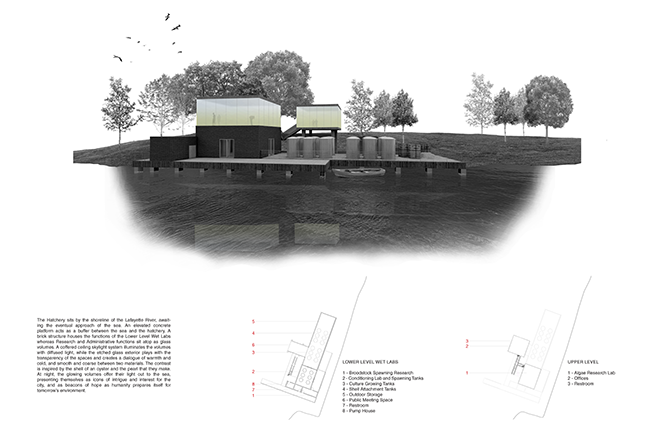
“The Hatchery” by Mustafa Shafique from Virginia Tech
Conducted simultaneously at Hampton University, University of Virginia, Virginia Tech, and
the Washington-Alexandria
Architecture Center, the competition is a design charrette that engages
students at all of the accredited schools of architecture in Virginia. Students
are given the competition program on a Friday afternoon at 5 p.m. They work
over the weekend to create a design solution and submit it by 9 a.m. the
following Monday. The top submission wins a $2,250 prize, with $250 prizes to
each “Best of School” honoree.
Launched in 1980, the competition is intended to promote
collaboration between the profession, students, and professors in Virginia.
Historically, the charrette has taken place in January, however over the last
several years, the competition has been hosted in September to accommodate an
ongoing scheduling conflict at one of the schools. Now that the conflict has
been resolved, the Prize weekend has shifted back to the spring semester to
better align with the demands of the academic calendar.
Development of the competition brief rotates between the
four schools annually — the 2020 Prize challenge was developed by Hampton
University.
About the Jury
Each school’s faculty reviews the submissions and sends up
to 10 finalists to Richmond for final consideration by the following
Jury.
The AIA Virginia Prize design competition kicks off the new semester by offering students the opportunity to win a $3000 award. The competition is a design charrette that engages students at all of the accredited schools of architecture in Virginia.
Conducted simultaneously at Hampton University, University of Virginia, Virginia Tech, and the Washington-Alexandria Architecture Center, students are given the competition program on a Friday afternoon at 5 p.m. They work over the weekend to create a design solution and submit it by 9 a.m. the following Monday.
Each school’s faculty reviews the submissions and sends up to 10 finalists to Richmond for final judging.
Development of the competition brief rotates between the four schools annually — the 2019 Prize challenge was developed by Virginia Tech.
Launched in 1980, the competition is intended to promote collaboration between the profession, students, and professors in Virginia. Historically, the charrette has taken place in January, however over the last several years, the competition has been hosted in September to accommodate an ongoing scheduling conflict at one of the schools. Now that the conflict has been resolved, the Prize weekend is shifting back to the spring semester to better align with the demands of the academic calendar.
Watch for announcement of the winner in the coming months. If you’d like to get involved, contact Rhea George at rgeorge@aiava.org.
The 2016 AIA Virginia Prize competition began at 5 p.m. on Friday, Sept. 16 and ran over the course of one weekend.
Students from Hampton University, the University of Virginia, Virginia Tech—Blacksburg, and Virginia Tech—Washington Alexandria Architecture Center (WAAC) were eligible for the competition.
The 2016 Prize problem asked students to design a space bringing forward the many histories of the “First Africans in Virginia” historical marker located next to the Old Point Comfort waterfront walkway near Fort Monroe National Monument. The space needed to be a place for contemplation, congregation, participation, celebration, and performance. More problem information can be read here.
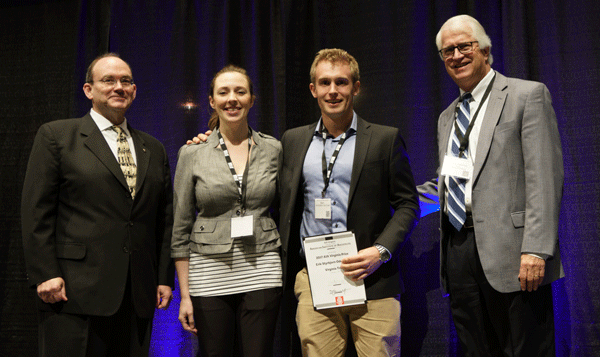
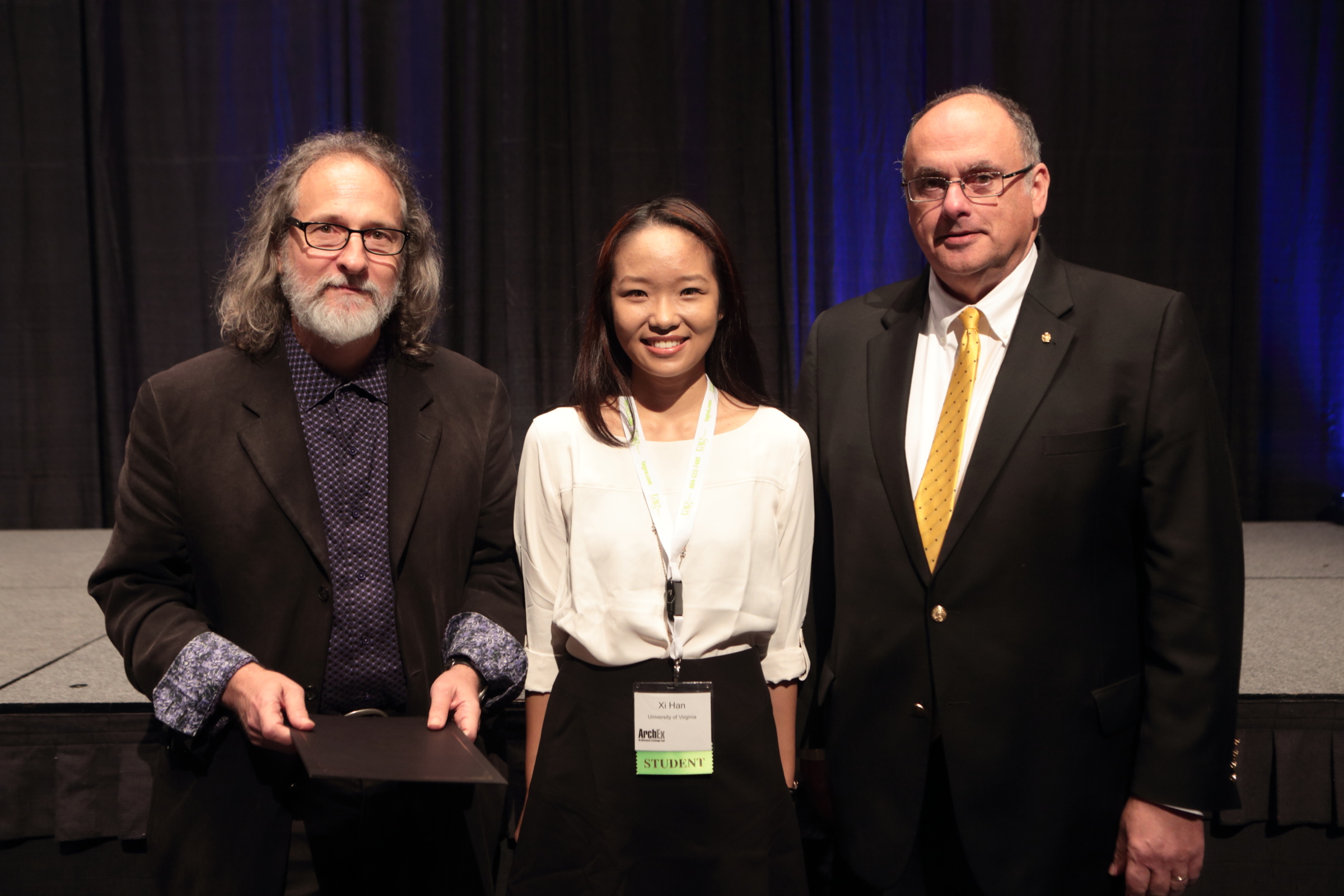
Jury Chair, Chuck Swartz, AIA, 2016 AIA Prize winner Xi Han, University of Virginia, and AIA Virginia President, Nick Vlattas, AIA
The Jury:
Chair: Chuck Swartz, AIA
Timm Jameson, FAIA
Johanna Huddle, Assoc. AIA
Kristin Baum, AIA
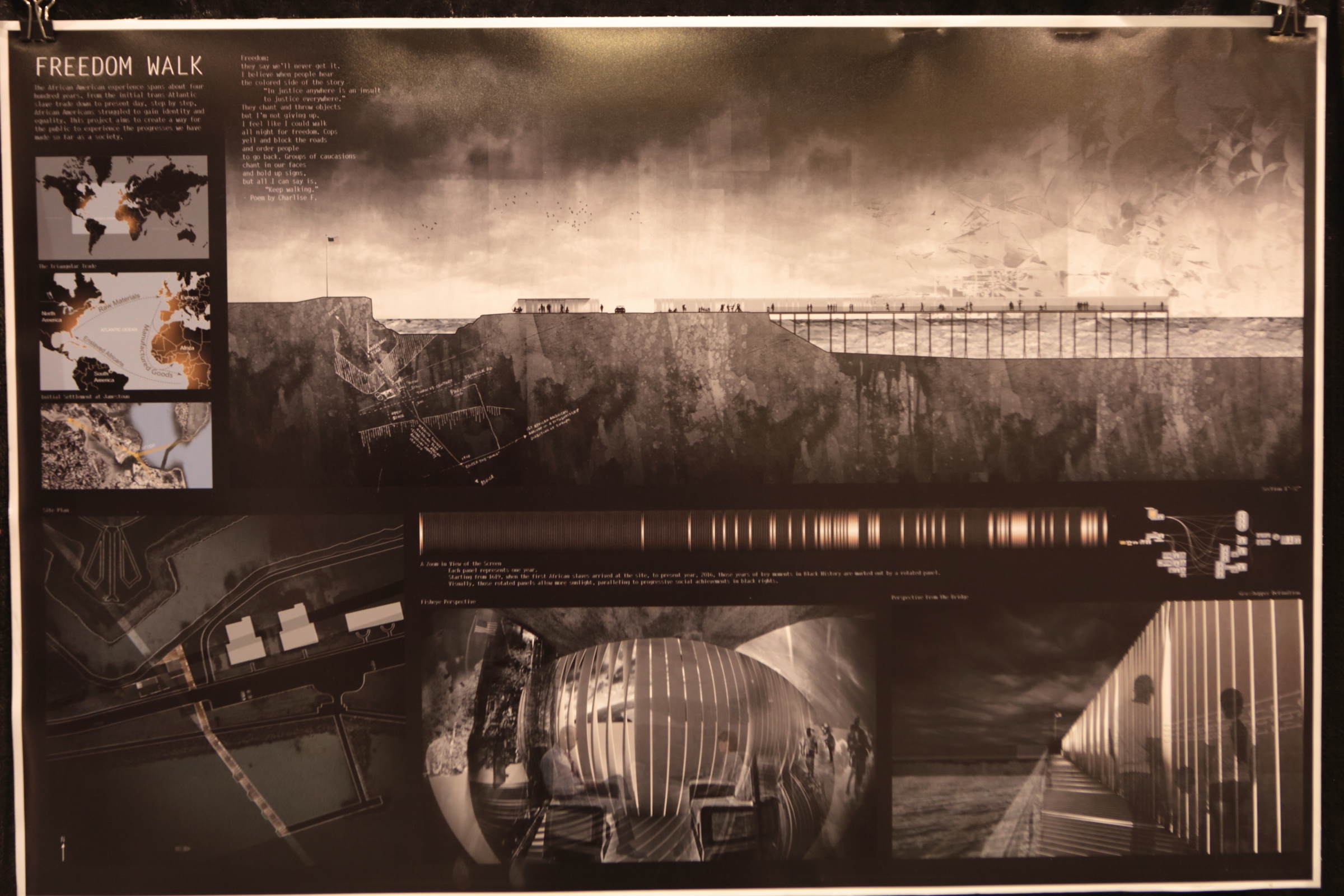
The Honorees: 2016 AIA Virginia Prize Xi Han, University of Virginia Said the jury: The design did a very good job connecting to the journey, the water, and the existing structures. The way that the site would change depending on the weather, time of year, and time of day, would make it a destination for travelers to see multiple times.
2016 AIA Prize winner Xi Han, University of Virginia.
Best of School — Hampton University
Iroda Karimova
Said the jury: The design was simple and very strong visually. The balance between the collective and the contemplative was handled very well.
Best of School — University of Virginia
John Hatcher
Said the jury: The ideas and reasoning for the designs were very well thought out. The bird’s next walkways ended up being a very elegant solution to pedestrian travel.
Best of School — Virginia Tech
Divya Nautiyal
Said the jury: A very powerful design with a lot of flexibility for different events. The balance of action and contemplation was very good.
Best of School — WAAC
Ian Hunter
Said the jury: Understood the brief more than other submissions. Strengthened the presence of existing events with its emphasis on the experience.
Certificate of Merit
M. Ryan Delaney, WAAC
Carlin Tacey, WAAC
Notable
Luke Dale, Virginia Tech
Dennis Daniels, WAAC
Rachel Flanagan, Virginia Tech
Philippa Koenig, WAAC
Qian Li, Virginia Tech
Julian Lin, WAAC