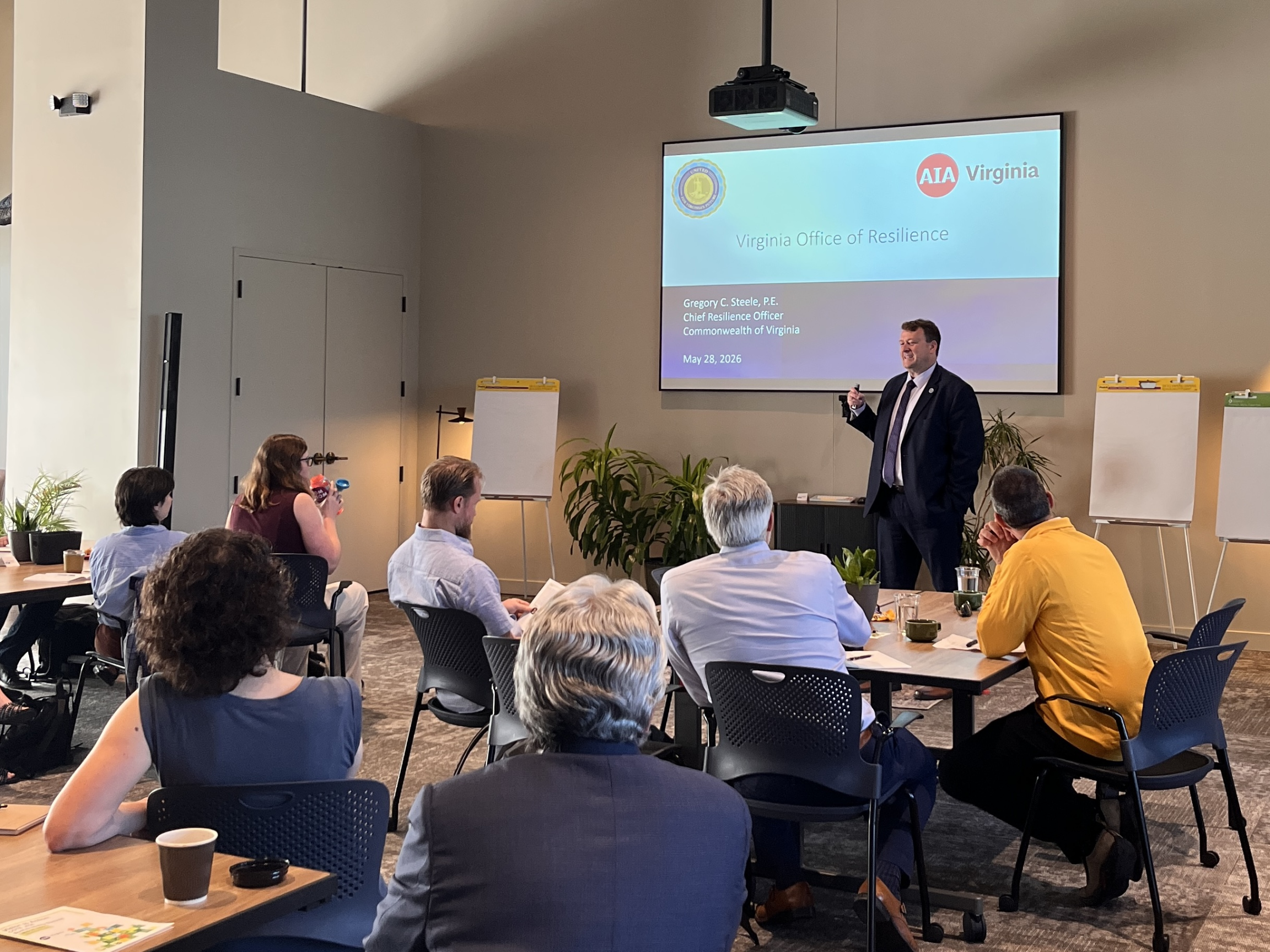
On May 28th, AIA Virginia COTE launched their very first Sustainability Summit: Vision to Action! The one-day event was created to bring together professionals interested in sharing and learning more about fostering sustainable practice in Virginia.
The day kicked off with an exciting keynote from Greg Steele, Chief Resilience Officer for the Commonwealth of Virginia, a governor-appointed position dedicated to fostering cross-sector dialogue and informed resilience decision-making in the Commonwealth. Greg described the work he and his team were doing in the Office of Resilience, which was created in 2025 under former Governor Glenn Youngkin, including Chairing the Interagency Resilience Management Team made up of almost 20 different state organizations, and launching a University Collaborative Workgroup between Virginia’s public universities to share data and response planning.
Quick but impactful 5-minute presentations by sustainability subject matter experts prompted roundtable discussion in the morning and afternoon sessions. Attendees broke into smaller groups to discuss topics including advocacy, legislation, codes, electrification, decarbonization, and resilience. Each round table discussion concluded with a report back to the full group, noting priorities, possible action items, and topics for future discussion.
Attendees finished the summit with a final prioritizing work session, listing the following priorities for the coming year and identifying champions to spear head each action:
Develop and distribute a local resilience toolkit
Review and evaluate the High Performance Building Act
Analyze effective data use for sustainable design
Build involvement in building code cycles from architects and allied professions
Create a carbon reporting task force
Attend a COTE meeting or event
COTE would like to thank all attendees and speakers for a wonderful day filled with great discussion and insights. We hope to see you next year!
Embracing Adaptability in Design and Resilience in an Ever-Changing World
If the past few weeks and months has taught us anything, it’s that change is no longer the exception but rather the constant. In a time of rapid transformation, from climate and technology to policy and community needs, adaptability has become an essential design tool. And with it, resilience becomes our north star.
Late last week, we saw torrential rainfall cause deadly flooding and highlighted how traditional infrastructure and even building standards fail under intensifying climate pressures. This is magnified by ever-changing budget cuts and policy changes. As architects, we must elevate design thinking and engage communities in infrastructure planning. It is no longer a choice, but a necessity.
Today’s challenges demand more than flexibility. They require us to anticipate, to respond to, and to lead through designing spaces and systems that can meet the moment and grow with the needs of those who inhabit them. The ongoing Venice Architecture Biennale theme “Intelligens. Natural. Artificial. Collective.” explores the opportunities to address the climate crisis, rethinking how we design, build and live around the globe.
We see flexibility and change in action across the Commonwealth: schools that reimagine learning environments, housing that adapts to address the needs of the most vulnerable, civic spaces that welcome many, and infrastructure shaped by sustainability and stewardship. These aren’t just projects. They are acts of collective foresight and care.
What I have learned is that the strategies we use to address needs are no longer hypothetical. They are much needed actions rooted in recent tragedies and successes. Adaptability is not about letting go of our values; it’s about holding them closer as we navigate uncertainty. When we design with resilience in mind, we empower communities to face the future with confidence, and we reaffirm the role of architects as vital partners in shaping what comes next.
So this month, I invite you to reflect on how adaptability shows up in your own practice. How are you responding to unexpected challenges? How can your current or upcoming projects integrate adaptability now, anticipating tomorrow’s challenges? Whether through modular design, passive solar strategies, resilient materials, or community workshops, let’s push our profession forward. Engage local stakeholders and city officials to embed resilience goals and funding from the onset.
The opportunity to turn momentum into the tangible is now. Let’s meet this ever-changing world with creativity, clarity, and courage and continue to build toward a resilient future together.
Warmly,
Meagan W. Jancy, AIA, LEED AP bd+c President AIA Virginia
“People from all walks of life … must recognize the crucial role design can play in coping with the complexities and challenges of the future.” ~ Richard Farson, Ph.D.
Designing to Transform our WORLD
The peoples of our world are gradually coming to understand that many of the most pressing challenges of the 21st century— urbanization of the planet, the well-being of society, the resiliency of our communities—are fundamentally matters of design. Increasingly, governments, industry, and the general public are beginning to appreciate that the creativity, training, and experience of architects and designers are necessary if we are to realize the dream of healthy, productive, safe, sustainable, and livable communities.
First, Urbanization:
Today, more than half the world’s inhabitants live in urban areas. The pressing cultural and environmental concerns of
Helene Combs Dreiling, FAIA
urbanization demand new levels of accountability as we measure ecological performance, energy use, density relationships, and dwindling resources.
Quick policy or technological fixes—a dam here, a regulation there—may provide temporary relief, but typically lead to larger problems. The paradigms of urbanism desperately need recalibration to meet today’s and tomorrow’s global challenges. Who is best trained and equipped to inform and lead the decision-making process that will bring about new thinking about the fair and sustainable allocation of resources? Architects and designers.
Second, Health:
An issue that demands our leadership is health. When we think of health, the first thing that usually comes to mind is the medical industry and treating illnesses when people are unwell. What should be uppermost in our minds is not the treatment of illness, but how to keep people WELL.
Whether dense or dispersed, there is a growing appreciation for the value of planning and designing cities to support physical activity, sunlight, clean air, the use of sustainable and safe building materials, access to healthy foods, safety, and social connectedness. This is a transformational moment for understanding and addressing the health consequences of our cities, and for architects to take the lead to put knowledge, measurement, and innovation at the disposal of elected officials and community leaders. We can and must be the agents for a quality of collaboration among all the affected parties, especially citizens, that shapes environments that support human wellbeing and environmental health.
And third, Resilience:
Becoming a globally urban society intersects with a looming crisis of 21st-century life—global climate change. This may be the greatest challenge of all, and it cries out for the leadership of designers of all disciplines. While some still question that human activity is (for the first time in history) having an impact on global weather, what is beyond argument is that more and more of us are in harm’s way. This affects us with growing frequency in Virginia.
“Resiliency”—which I define as structures that can resist all types of destructive events and continue to provide their primary functions—is a major challenge to the design professions—and an opportunity to demonstrate the value of design. Structures so designed have the ability to reduce the magnitude and/or duration of disruptive events by anticipating, absorbing, adapting to, and recovering rapidly from natural and human-caused disasters. Stated more simply, resilience can be defined as the ability to bounce back after a disturbance or interruption. However, resiliency does not and should not be equated with a fortress mentality; instead, it can be a way of thinking that links our work intimately with site and climate.
Conclusion
Public-opinion polls, newspaper articles about local issues and politics, and anecdotal evidence all show that communities around the world are concerned about livability issues. Health, security, transportation, safety, schools, sustainability, resiliency, economic development, and productivity all contribute to quality of life. All are influenced (in some way) for better – and, for worse – by the way we shape the built environment.
My dear friend, the late Richard Farson, PhD., recognized author and psychologist I quoted above, believed that we are in the midst of an emerging “Design Century.” In Dr. Farson’s words, “The stakes are high. The next few decades will determine the survival of our civilization. We will either design our way out of this crisis, or we won’t make it. We will succeed only if design thinking becomes the organizing discipline of the future!”
Helene Combs Dreiling, FAIA
Executive Vice President
AIA Virginia