
Art of Practice Detailed Agenda Announced

PROGRAM SPONSOR: ITEK Construction + Consulting, Inc.

Seasoned and emerging leaders, from practices of all sizes, sole proprietors, allied organizations, educators, etc. from across the Commonwealth will converge on March 14, 2025, at the Tower Club Tysons Corner for the Art of Practice forum. The program is intended to cultivate strong leaders, identify solutions to common business challenges, advance business practices, and fuel collaboration across the profession.

Registration is now open for the day-long event in Northern Virginia. Space is extremely limited, so early registration is strongly encouraged. Tickets are available to members and non-members. Participants can earn 6 learning units.

Art of Practice is currently sponsored by:
ITEK Construction + Consulting, Inc. (PROGRAM SPONSOR)
Moseley Architects (Lunch Sponsor)
O’Hagan Meyer (Lunch Sponsor)
ASSA ABLOY (Reception Sponsor)
Ames & Gough (Coffee Sponsor)
Keith Fabry (Signage Sponsor)

If you would like to sponsor Art of Practice, please contact Jody Cranford

About the Program

10:00 a.m. Winning Work: Storytelling and the Value in Architecture
Effective communication skills are critical to the success of any business leader. Take part in an intensive presentation — developed specifically for architects — to understand how and why people make decisions, how to craft messages that communicate your value, and how to move clients to choose you.
Speaker: Kelly O’Keefe, Founding Partner and CEO, Brand Federation

11:00 a.m. Rethinking the Future of Work: Neurodiversity in Design
Participants will learn how fostering an inclusive environment and accommodating environment for neurodiverse people can enhance holistic design outcomes and boost productivity through practical, actionable strategies.
Speakers: Corrie Cohen, Assoc. AIA, Architectural Designer at WPA and Alison Allred, CID, IIDA, Senior Interior Designer at WPA

12:00 p.m. Lunch sponsored by Moseley Architects and O’Hagan Meyer

1:00 p.m. Broad Perspectives: Macroeconomics
Review Macroeconomics 101, discuss local/national economy’s impact on the profession, how the major sectors of the economy are influenced/affected by interest rates and recognize the economic forces/factors that govern public and private funding sources.
Speakers: Terry Clower, Ph.D., Director, Center for Regional Analysis, Stephen S. Fuller Institute, George Mason University and Keith Waters, Assistant Director, Stephen S. Fuller Institute, George Mason University

2:00 p.m. Peer Panel: Strategic Planning for Strong Firm Culture
Failing to plan is planning to fail. Whether your firm is facing the retirement of a key leader, a merger, or simply considering how to nurture the next generation of principals, leadership transitions can often take years — even with advance planning and management. Hear how your colleagues faced a host of issues and positioned their firms for success in the face of change.
Speakers: Donna Phaneuf, FAIA (VIA design), Andrew McKinley, AIA (VIA design), Susan Pryor, AIA (Quinn Evans), Mel Price, FAIA (Work Program Architects), Helene Combs Dreiling, FAIA (The Three Aspens)

3:00 p.m. Break

3:15 p.m. Firm Size Roundtable Discussions
Taking a cue from the most popular part of AIA Virginia’s Firm Size and Non-Traditional Practice Roundtable meetings, we’ve reserved time for peer-to-peer learning. Discuss key themes from the day, discover best practices and share your experiences with colleagues.
Speakers: Maggie Schubert, AIA, (small), Andrew McKinley, AIA, (mid-size), Charles Piper, AIA (large), Bill Conkey, AIA (non-traditional)

4:15 p.m. Roundtable Report-Out
4:45 p.m. Closing Remarks
5:00 p.m. Cocktails and Networking

Tickets
AIA members: $175
Assoc. AIA member: $135
Non-member: $200

REGISTRATION CLOSES ON MARCH 3, 2025 at 8:00 PM – Get your tickets now!

Lodging
Below are two hotels within walking distance of Tower Club:
Tysons Corner Marriott
Hyatt Regency Tysons Corner

About the Art of Practice
The biennial Art of Practice was launched in 2017 with the purpose of providing current and aspiring firm leaders and with timely, relevant, actionable advice on how to grow and sustain their businesses.

Read the key takeaways from the 2017 event and see the photo gallery.
Roundtables Wrap Up

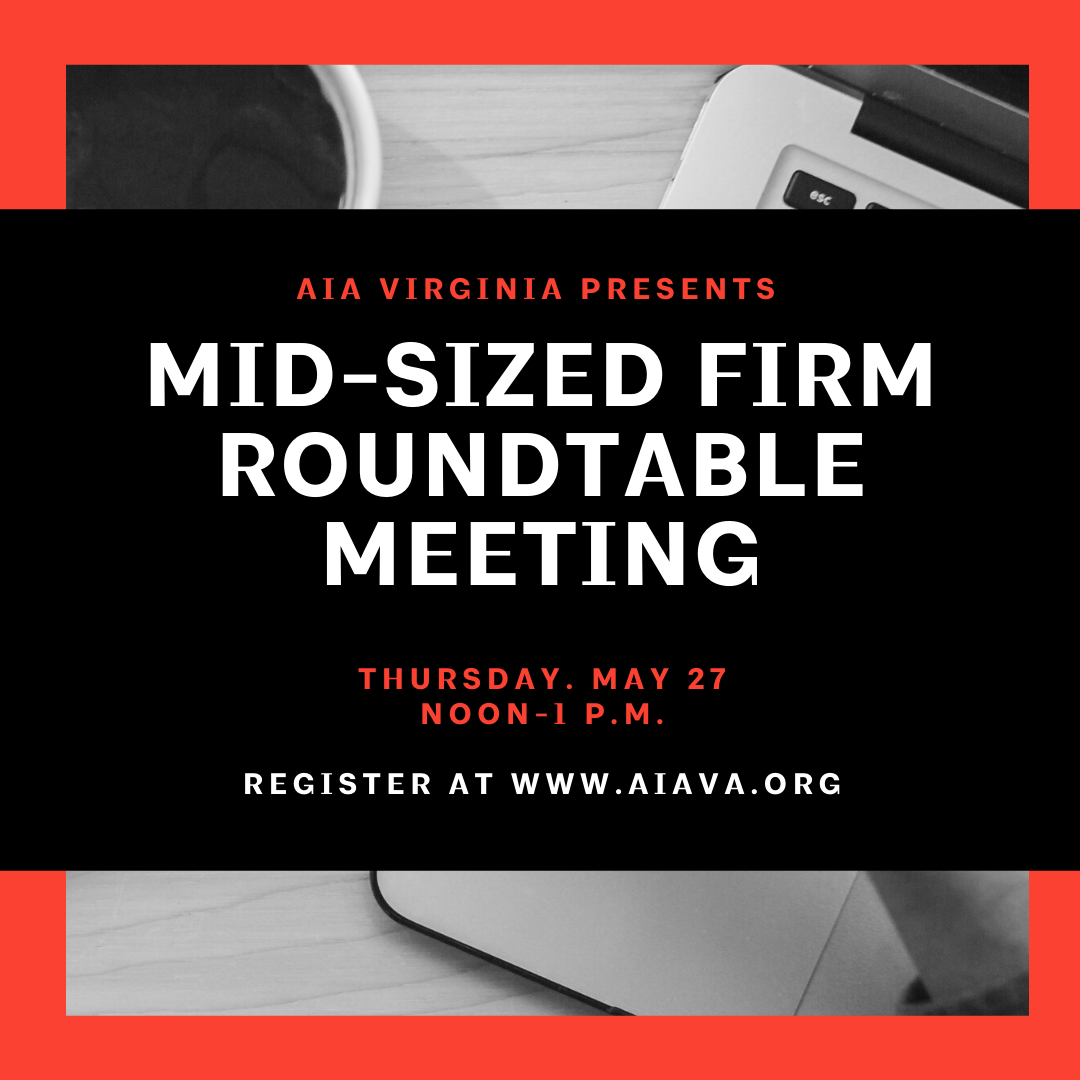
The Meeting of the Roundtables [Small Firm, Mid-Size Firm, Large Firm, and Emerging Professionals] occurred on Thursday, February 25. The below captures the highlights of each conversation. Please plan to join us for the next session on May 27.

Large Firm Roundtable         

Topic 1: Remote Work and Transitioning Back to the Office

  • Employees have the choice on when to return to the office in person
  • Some firms have purchased PPE for employees and performed deep cleaning for the office
  • Many firms have requirements for masking when in common areas and moving throughout the office
  • In general, firms have not imposed a requirement for employees to vaccinate
  • It was noted that there are varying requirements for re-opening in different states, thus posing challenges for firms with multiple offices in the U.S.
  • One firm leader shared how vaccinations are not embraced by everyone which will influence office policy development
  • Some firms shared that productivity (measured as revenue per employee) has been high during this period of remote work
  • Some firms classified 2020 as a “so-so” year in terms of financial performance

Topic 2: Justice, Equity, Diversity, and Inclusion

  • The 21 Day Racial Equity Habit-Building Challenge by the American Bar Association was shared as a resource: https://www.americanbar.org/groups/public_contract_law/leadership/21-challenge/
  • Firm leaders thought they should let the next generation take the lead on JEDI issues
  • Some firm leaders are mentoring more than ever during the pandemic
  • There was consensus that firm leaders need to understand our future generation as individuals, particularly minorities
  • Some firms have established a J.E.D.I. Committee
  • Firm leaders were encouraged to use Virginia NOMA as a resource.

Topic 3: Cultivating Emerging Professionals

  • One firm leader indicated that emerging professionals were obtaining knowledge and advancing it on their own
  • Firm leaders reported that it seemed emerging professionals in their firm missed the camaraderie of the office environment and desire to come back; however, are accomplishing a great deal from home
  • It seems that conversations on EDI have flourished amongst this demographic
  • There is a concern by some firm leaders if the development of some emerging professions is “falling through the cracks” in the remote work environment
  • Some emerging professionals have risen as key players in contributing to firm vision and strategy during this time
  • The question of how to grow the firm without growing the firm’s real estate was discussed
  • It seems the vast majority of emerging professionals desire flexibility to work from home and the office
  • Some firm leaders believe that the pandemic will change the culture of the profession; the office will likely become a destination for specific tasks opposed to pre-COVID times where the office was a place that you “go just to go”

Mid-Size Firm Roundtable

Topic 1: Remote Work and Transitioning Back to the Office

  • There is a blend of approaches: some are working remotely, bringing in staff in shifts, and some are back in the office.
  • Once teams are vaccinated, many envision returning to the office
  • There seems to be adequate information about safe space planning.
  • Some firms are offering incentives to encourage vaccination, paying for vaccinations, or providing time off. None were mandating vaccination as a requirement to return to work.
  • Site meetings and construction administration have been flowing fairly normally. Some are hosting hybrid meetings or in-person meetings with 6-feet social distance and movement every 15 minutes. Many try to schedule meetings early or late in the day when fewer people will be onsite.

Topic 2: Justice, Equity, Diversity, and Inclusion

  • One firm formed a diversity and inclusion council that is charged with reviewing all policies. They began with evaluating recruitment and legal and have been working for 6 months.
  • Some have not adopted any J.E.D.I. initiatives
  • Hiring/recruitment has been challenging
  • One firm just hired several new team members. Another hired several new people in June right out of school and developed new virtual training/orientation methods to support them.
  • One firm went through the JUST process which is posted on their website. They used the information like a report card and have implemented several new policies and practices as part of their continuous improvement efforts.

Topic 3: Cultivating Emerging Professionals

  • Several firms are seeking to hire emerging professionals at this time.
  • Shortly before the pandemic, one firm hired a student part-time. He has now graduated and is full time. Because the firm is not planning on hiring anyone else, he is advancing very quickly out of necessity.
  • One firm hired several new graduates and has implemented regular virtual check-in meetings and virtual check-sets to help support them.
  • There are a lot of people participating in ARE support sessions which is helping them to be well prepared for the test. One office just had a staff member pass the ARE.
  • There was some discussion about mentorship programs in Seattle and New York. The group talked about the differences between mentorship and training as well as challenges of mentoring in a smaller firm.
  • One firm is considering a more structured mentorship program and evaluating their existing methods. They have had some success with summer interns who are “attached at the hip” with a firm principal. This firm is back in person, so it is easier – to do this.
  • Because of the virtual environment, one firm in creating more structure to their mentorship programming out of necessity.
  • The group discussed the various challenges of having multiple partners with different styles.
  • One firm matches each new hire with an in-house “mentor” who helps them on the job.

Small Firm Roundtable

Topic 1: Remote Work and Transitioning Back to the Office

  • Some firm leaders shared that it is difficult to manage projects remotely as a small firm
  • One firm has employees working in the office but seated 12’ apart with masks optional at one’s desk
  • One firm requires clients to make an appointment before visiting the office; “walk-ins” are prohibited
  • A firm leader stated that the company was so busy that they are turning down clients

Topic 2: Justice, Equity, Diversity, and Inclusion

  • One firm made Martin Luther King Jr. day a paid holiday for staff. This day will eventually be made a day of service for the firm
  • A firm leader shared that the company is being more intentional about casting a “wider net” in search of interns
  • J.E.D.I. conversations take on a much different context in small firms; for example, firms with 3 to 4 people
  • Several firms believed they could make a stronger impact with J.E.D.I. by serving the community (example projects mentioned: converting a church to a community center pro bono for a disadvantaged neighborhood, making oneself available to the Government as a contract vehicle, “Architects Anonymous” pro-bono services program]

Topic 3: Cultivating Emerging Professionals

  • The group discussed AIA Virginia’s Amber Book ARE prep scholarships being sponsored by the Branch Museum of Architecture and Design
  • The Chair of The Branch voiced opportunities for engagement with the 501c3

Emerging Professional’s Roundtable

Topic 1: Remote Work and Transitioning Back to the Office

  • Overall, most firms have been supportive of the remote working arrangements
  • Some reported that their teams have become more dynamic and flexible in their scheduling. The group appreciated that flexibility and most hoped that it would continue.
  • Document review and redlines/mark ups have been challenging.
  • The group discussed the various advantages and challenges with Blue Beam, Miro, and Mural
  • Some discussed the challenges of remote work during the early career stage
  • Most are still working remotely, though some are in the office.

Topic 2: Justice, Equity, Diversity, and Inclusion

  • Some firms’ J.E.D.I. efforts have been disappointing or have seemed performative (rather than substantive and sustainable)
  • The group discussed the challenges of bringing J.E.D.I. issues to firm leaders
  • One firm is trying to identify information to see if there is unconscious bias in the review process
  • The size of the firm seems to impact diversity; larger firms are (in general) while smaller firms seem less diverse
  • There seems to be some level of “tokenism” in some firms
  • AIA should reward/recognize/celebrate firms for genuineJ.E.D.I. efforts
  • Michael Marshall – who has suggested a hiring diversity/staffing rating system like LEED was discussed.
  • The group wondered how many firms are willing to sponsor visas for international applicants.

Topic 3: Cultivating Emerging Professionals

  • It can be difficult to get the information/support that one would normally get when in the office
  • It is difficult to build professional relationships within firms in a remote setting
  • Some have felt like there is a lack of connection and communication in the virtual space.
  • Despite good intentions by firm leaders, some are not feeling supported and don’t know how to ask for it.
  • It is very hard to learn when personal or mentorship relationships are absent.
  • Some were uncomfortable asking for things/support/help because they feel like firm leaders are doing them a favor by keeping them or offering more flexibility in scheduling
  • “It feels like you should know what you’re doing, but you don’t — and you don’t know who to ask?”
  • Being paired with a firm “mentor” (who you aren’t afraid to ask questions/ whose “job” it is to help you) has been a successful approach
  • Some didn’t find out until several years into their architecture program that a Masters program was necessary to be licensed and that expensive testing was necessary (following a long internship/training process).

Mid-sized Firm Roundtable Meeting

(Mid-sized Firm Roundtable for 10 to 24 employees)

The “Meeting of the Roundtables” serves as an educational opportunity to bring AIA members together from firms of various sizes to discuss pertinent practice topics in a structured and facilitated format.

Engage in a dialogue regarding how the AIA can best position you to be successful in creating positive change in the built environment and the profession.

Earn 1.0 AIA LU

Register online.

Learning Objective 1:
Describe risk management techniques and best practices

Learning Objective 2:
Discuss human resource management and understand how to implement best practices

Learning Objective 3:
Discuss best practices for firm transitions and describe how to support emerging leaders

Learning Objective 4:
Share your experiences navigating firm management during an economic downturn. Discuss collaboration, business development, and project management during COVID-19 and hear the experiences of other firm leaders and designers.

Earn 1.0 AIA LU

Register online.


Mid-Size Firm Roundtable

Mid-Size Firm Roundtable
for 10 to 24 employees
Friday, June 5, 4:00 p.m. – 5:00 p.m.
Moderated by Andrew McKinley, AIA of VIA Design
Register>>

Please register for the roundtable that corresponds with your respective firm size. You may register for multiple roundtables, but note that you can only receive 1 LU regardless of how many you attend.