
Maintaining Public Connection Breathes Life into Historical Landmarks

The revitalization of Fire Station #1, the longest continuously-operating fire station in Virginia, illustrates how, at best, the relationship between architecture and the public is one of reciprocity. Landmarks like Firehouse One invite interaction and add value to people’s lives, and in return, the community engages with the building, breathing new life and creativity into its existence. The purpose of historical and adaptive reuse in architectural practice is to maintain that connection and encourage the continued dance between the constructed environment and those who dwell there.

The project between Hill Studio and Old School Partners rehabilitated the historic Fire Station #1 building through a public engagement design process and restored the building making it more accessible to the public than ever before. “Made in Roanoke” is displayed in large letters on the lower level with a large open format retail space outfitted for local furniture manufacturer, Txtur’s. The second floor features a compatible anchor tenant—a specialty-themed boutique hotel. The facility repurposes the large old bunk room space into a lobby and reception for small events while preserving the historic skylights and firepoles. As a part of the process, Old School Partners granted a permanent easement on the property to the Virginia Department of Historic Resources. Originally built to protect us from the destruction of flames, Firehouse One is now protected by the city and community and given a new notch in the timeline of its life, with its spirit of public service embedded in every element of the building. Read more here about this award-winning project.
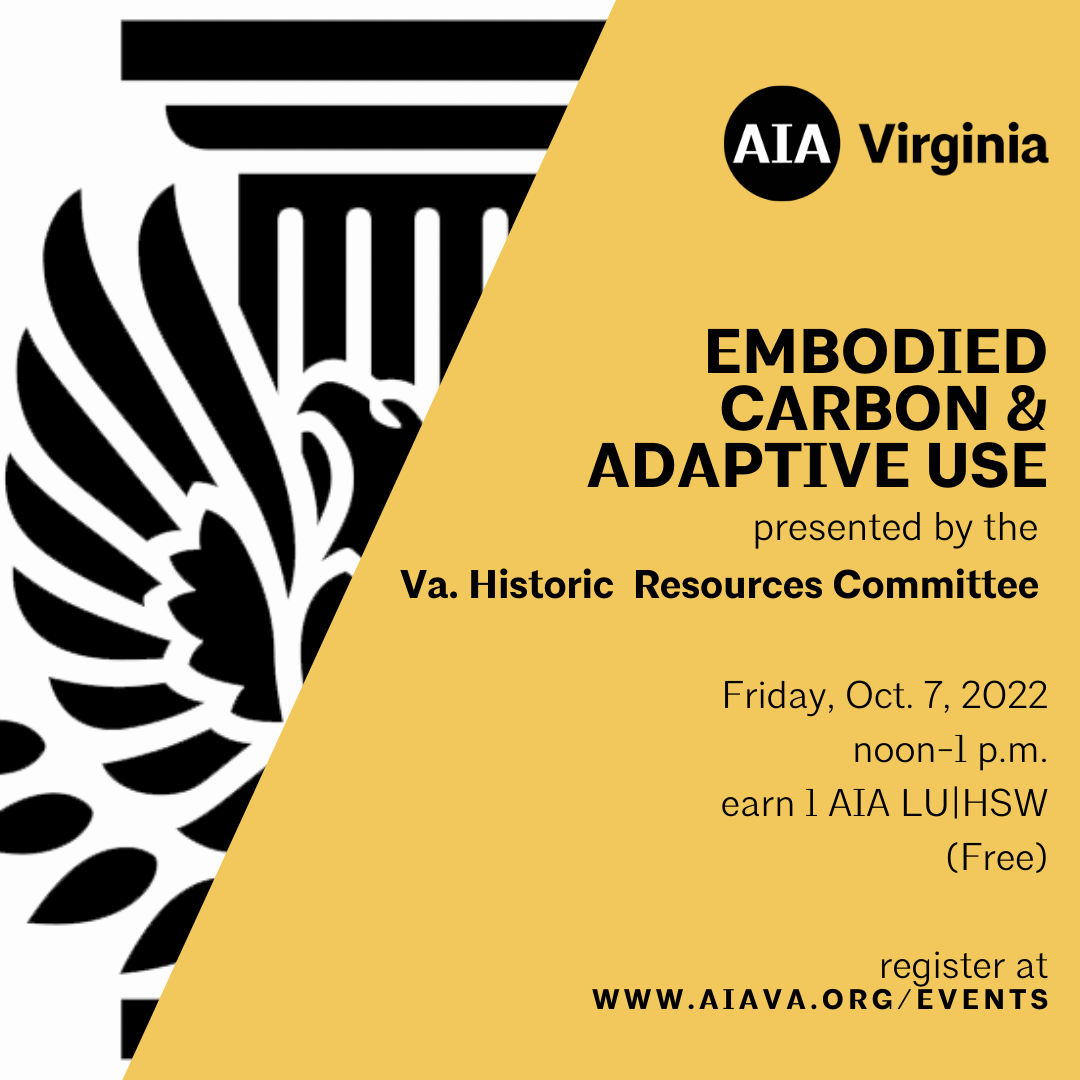
Embodied Carbon and Adaptive Use

In a continuation of COTE’s Embodied Carbon 101 series, Virginia’s Historic Resources Committee presents “Embodied Carbon and Adaptive Use.”

Existing buildings represent significant investments in energy and resources, so it stands to reason that one of the best ways of reducing embodied carbon is to adapt and reuse them. Discover strategies for maximizing the potential of the already embodied carbon in existing building stock.

Earn 1.0 AIA LU|HSW

Register online.

Va. COTE Launches Embodied Carbon Series

Virginia’s Committee on the Environment (COTE) is pleased to announce the launch of Embodied Carbon 101. The 12-part series is free and takes place weekly on Tuesdays from noon–1:30 p.m. Each segment of the series features pre-recorded content followed by discussion and Q&A period with a subject matter expert.

Embodied Carbon 101 is designed to help designers understand embodied carbon and immediately apply that knowledge to projects to reduce emissions and get to zero carbon.

Unlike operational carbon, which can be reduced during a building’s lifetime, embodied carbon is “locked in” as soon as a building is completed. Over 12 courses, you’ll learn how to measure, manage, and implement practical solutions from expert practitioners including architects and sustainable building product manufacturers. Buildings contribute about 40% of the world’s carbon emissions, and embodied carbon is a big slice of the pie. Let’s all do our part to get to zero together.

Earn 1.5 AIA LU | HSW per course

Courses

July 19: Embodied Carbon 101: Basic Literacy

July 26: Embodied Carbon 101: Environmental Product Declarations (EPDs)

Aug. 2: Embodied Carbon 101: Envelope

Aug. 9: Embodied Carbon 101: Structure

Aug. 16: Embodied Carbon 101: MEP

Aug. 23: Embodied Carbon 101: Interiors

Aug. 30: Embodied Carbon 101: Procurement

Sept. 6: Embodied Carbon 101: Carbon Accounting

Sept. 13: Embodied Carbon 101: Certifications + Commitments—An Overview

Sept. 20: Embodied Carbon 101: Certifications + Commitments—A Deeper Dive

Sept. 27: Embodied Carbon 101: Making the Case

Oct. 4: Embodied Carbon 101: Process + Firm Culture

The series is hosted by Virginia COTE with support from AIA Virginia’s Knowledge Community Grant program and the following annual partners:

SILVER

Mafi

BRONZE

Bamforth Engineers + Surveyors

The series was developed b the Boston Society for Architecture with support from CLF Boston, the Boston Hub of the Carbon Leadership Forum.