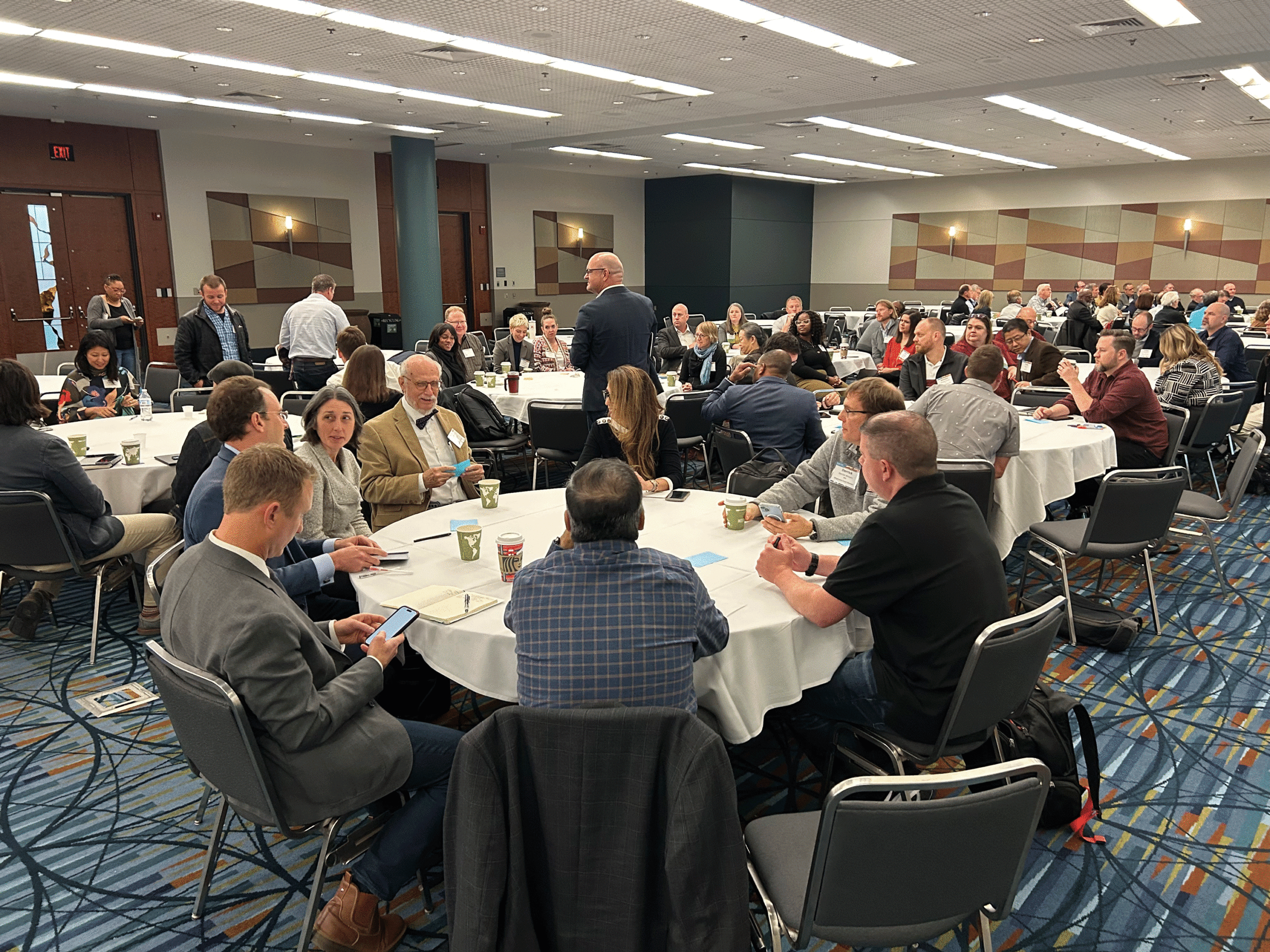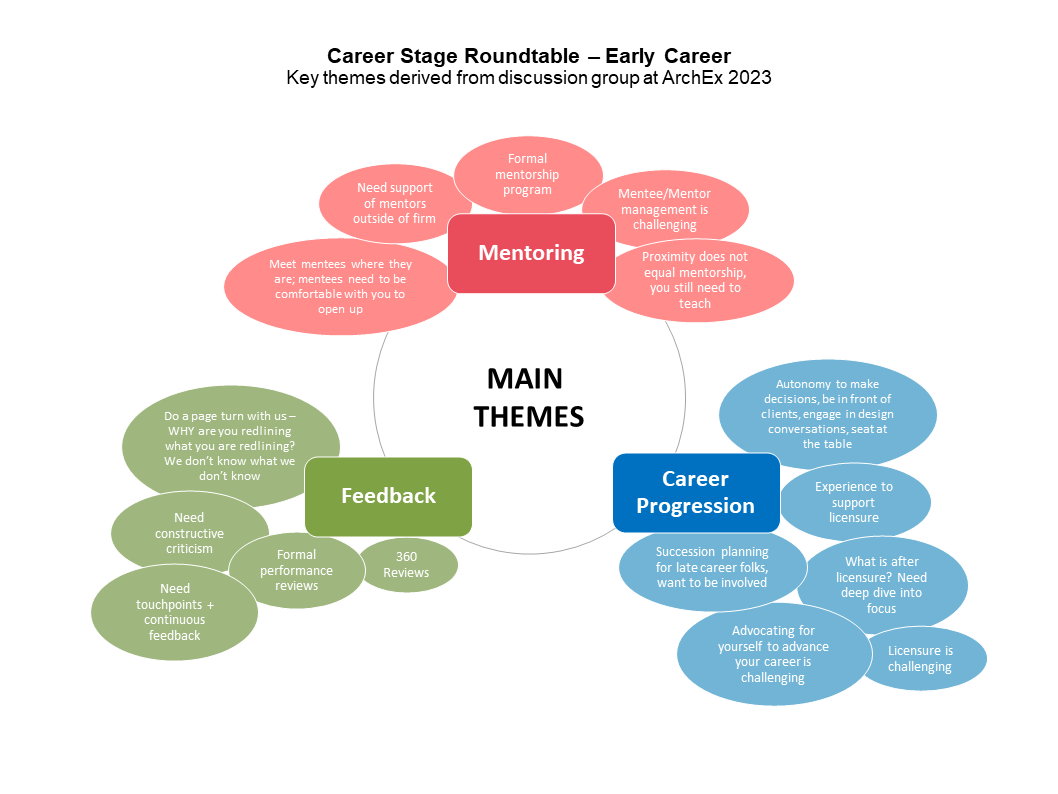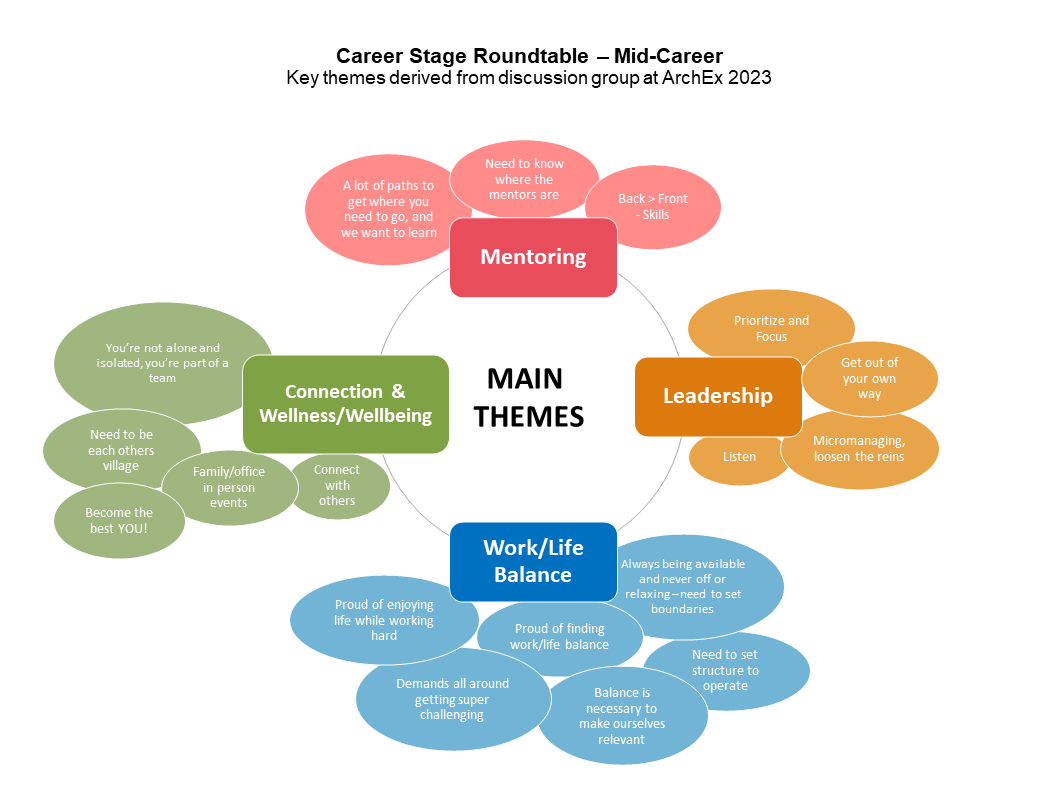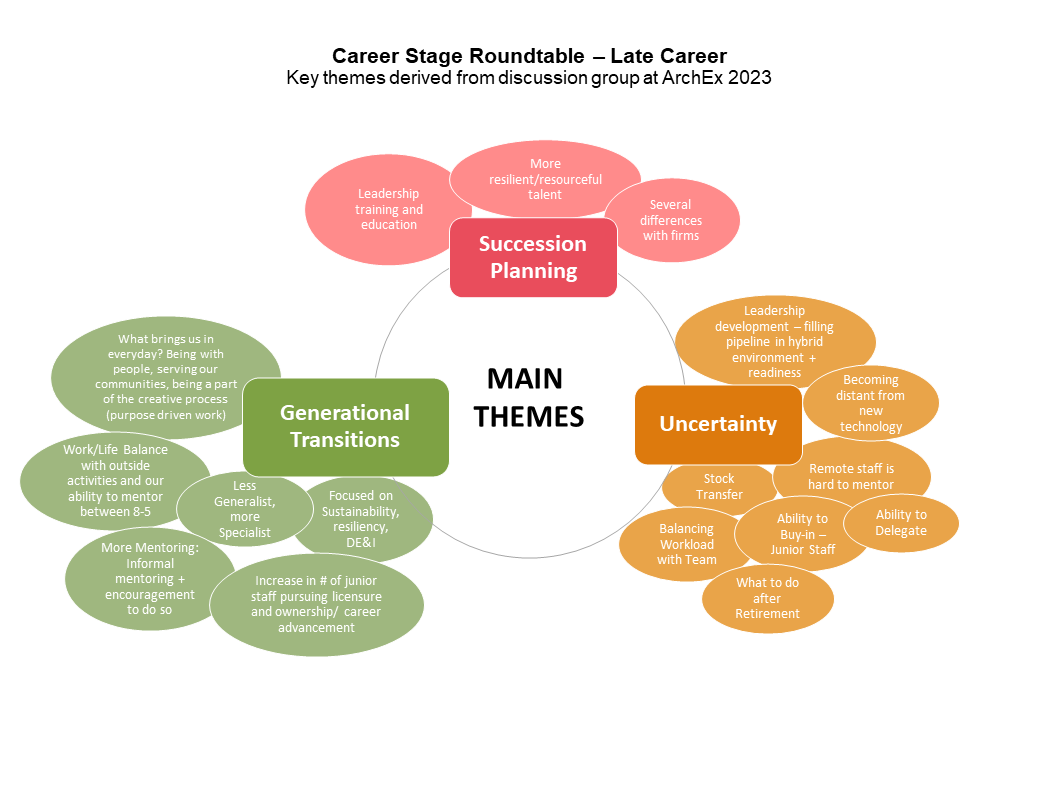
Our Career-Stage, Firm-Size, and Non-Traditional Roundtables all met virtually over the past few weeks.
We’ll be meeting again on Zoom on August 19th and 26th and then get together in person at ArchEx, November 4-6, 2026, in Richmond. Watch your inbox to join in these important conversations with your peers. And feel free to reach out to any of the chairs with questions and to become involved.
Small Firm Roundtable
Chair: Maggie Schubert, AIA
notes coming!
Mid-Size Firm Roundtable
Chair: Andrew McKinley, AIA
Discussion about titles, roles, and staying billable
Juggling project size and scale is a challenge with resources. You have the team you have; sometimes you have the skill well covered, but other times you aren’t large enough to have everything you need.
- We sometimes see skill degradation when shifting between project typologies and size. Trying to keep the $20M dollar project skills sharp, along with the smaller $ work.
- Challenging to manage residential work along with production between commercial.
- One firm no longer does residential but now shares these projects with ‘another’ firm. Multi-fam and townhouses are within the ‘commercial’ sphere.
- Mutli-disciplinary – Interiors team members awesome. VIA and SMBW – no single-fam residential work, but some multi-fam. Will often partner with some larger firms – interiors folks supporting larger architecture firm.
What do you hope to get from this conversation?
- Transition plans – BD has one, it’s going… how is it going for rothers
- Do we engage in any formal project manager training?
PM training
- Project management training/seminar? PSMJ is an example training – great 2-3 day thing, in Las Vegas, didn’t internalize as an initial learning experience. Need to balance timing of a training with exposure of real-world situations
- ~5-6 year mark is when folks can typically start to handle responsibility. They are capable of making decisions but don’t necessarily have confidence.
- LAB program! https://www.aiava.org/leaders-in-architecture-and-business/
Firm ownership transition
- Andrew shared his story of buying out VIA – 8 years in total, two phases of buy-out
- Will’s experience was more expedited – buy-out happening this year
- Be realistic about the value of the firm.
- Sweat equity doesn’t necessarily equate to value.
- Make sure systems are in place
- Sole proprietor is a little different than partners that will bridge the transition. Need to be willing to step back and let folks attempt, just don’t run the ship aground.
Accounting, Bookkeeping, and Resource Management
- Having a software helps get invoices out the door quickly. Make it as frictionless as possible. AR easily within 30 days.
- Factor (vector?), Ajera, others?
- Some are doing bookkeeping in house. Outsourced accounting does not always think out of the box. CPA’s are not necessarily creative. A creative tax strategist can be very valuable.
- VIA – OAS outsourced accounting. Shifted CPA and outsourced accounting.
Large Firm Roundtable
Chair: Lori Garrett, FAIA
Four of us met virtually to discuss the challenges and opportunities for large firms. Though all of us worked at firms with more than 50 employees, there was a diversity of perspectives represented:
- Three firms had multiple offices; one had only one office.
- Two firms were more national in scope with both architects and engineers on staff and had over 500 hundreds of employees; the other two firms represented focused primarily on architecture in Virginia and neighboring states and had under 75 employees.
The discussion focused on the following questions.
Firm Culture
1. As some firms experience sudden change in size through being acquired, how do you deal with the resulting cultural differences?
2. How can you drive firm-wide culture without stepping on the toes of the smaller, local units?
3. What does effective mentorship look like for large firms? We discussed the use of specialized software which can support a mentorship program, generate meeting agendas, etc.
Attracting Talent
1. Employees want to grow and advance in their careers, so it is important to be transparent about opportunities for advancement. Most of our firms have established criteria that are discussed with staff.
2. One potential selling point to prospective hires (as well as clients) is that with a large firm, you can always scale down for a more personalized experience, but a small firm can never scale up to offer the breadth of resources and experience of a large firm. (Universities do this when they advertise for example “the energy of a large, renowned public university with the personalized, community-oriented feel of a smaller college”.)
Future Discussion
We will meet bi-monthly for a virtual call to discuss topics of interest and best practices. We have tentatively set the following meeting dates and topics:
- March 13 — Career Advancement
- May 15 — AI
- July 17– Firm Structure
- September 18 —TBD
Those interested in participating can email lgarrett@glaveandholmes.com
Non-Traditional Roundtable
Chair: Bill Conkey, AIA
Job Descriptions
- Strategy consultant
- Create as-built documents
What strengths do you bring when working with non-architects
- Work in an iterative process turning criticism of proposals into a positive evolution of the proposal
- Problem solving skills
- Ability to apply design thinking to a variety of challenges
- Architects are not business forward in terms of approach to potential problems
- Architects have the ability to hyper focus on issues of a variety of scales at one time
- Architects who leave the profession often end up in the work of IT because it requires similar problem solving skills
What can the AIA do better to engage with those in non-traditional architecture careers?
- AIA surveys currently assume that respondents are working within a traditional firm. These surveys should be modified to include members from a variety of different career paths
- The AIA could reach out to non-architects in adjacent fields to broaden its reach and educate the public on the various ways in which architects engage with the community.
- AIA programming should include business related topics such as HR and other similar issues faced by architects in addition to the more technical and theoretical subjects currently included.
Emerging Professional Roundtable
Chair: Carrie Parker, AIA
Purpose of Discussion
The session focused on identifying factors contributing to work–life imbalance among emerging professionals and exploring what currently helps—or could help—improve balance across the profession.
Key Themes: What Is Out of Balance?
Workload Volatility and Deadlines
Participants noted inconsistent workloads that lead to unpredictable and uneven deadlines. This volatility contributes to stress and makes long‑term planning difficult. There was a perception that this may be discipline‑specific and vary from person to person.
Client Expectations and Industry Practices
There is a perceived misunderstanding on the client side regarding the amount of work required to prepare architectural proposals, particularly for RFP responses. Additionally, firms that consistently agree to compressed schedules risk setting unsustainable precedents that clients come to expect and share with others.
Personal, Cultural, and Professional Pressures
Participants highlighted the challenge of balancing professional demands with personal and cultural responsibilities. One example discussed was the added strain of meeting intense deadlines while observing Ramadan. Additional pressures included studying for ARE exams and meeting family and community expectations. Cycles of burnout followed by recovery were acknowledged as a recurring experience.
What Would Help?
Access to Professional Development Opportunities
Hard‑hat tours organized with local chapters or within firms with active construction were identified as a valuable opportunity, particularly because construction administration / execution (CE) hours are among the hardest requirements to fulfill for AXP.
Flexibility in Work Schedules
Participants suggested that the traditional 9‑to‑5 schedule across the industry should be reconsidered. Greater flexibility was identified as a potential lever to support better work–life balance.
What’s Currently Working?
Alternative Scheduling Models
Core, flex, and summer hours were cited as effective existing practices that help individuals better manage their time and energy while meeting work responsibilities.
Key Takeaways
- Work–life imbalance is driven by a combination of workload inconsistency, client expectations, and firm‑level practices.
- Emerging professionals face layered pressures, including licensure, cultural obligations, and family responsibilities.
- Flexible scheduling and accessible professional development opportunities show promise as practical supports.
- There is an opportunity for the industry to reassess norms around deadlines and standard work hours to promote sustainability.
Mid-Career Professional Roundtable
Chair: Shawn Mulligan, AIA
What Feels Out of Balance?
Participants identified several overlapping sources of imbalance, many rooted in the inherent demands of practice and compounded by shifting expectations post-pandemic.
Career Transitions & Boundary-Setting
- The pandemic disrupted established rhythms, leaving many mid-career professionals without clear on/off transitions between work and personal life.
- Managing presence — being fully at work during work, and fully at home during home time — emerged as a core aspiration, not yet a reality for most.
- Late-night emails were cited as a persistent challenge; the practical suggestion of using delayed send was well-received as a low-friction solution.
Personal Pace & Family Time
| “I need my days to be slower — to sit at home, be with my kids.” — Rebecca Pantschyschak |
- The desire for intentional slowdown resonated broadly — not laziness, but deliberate recovery and presence.
Time Management & Expectations
- Calendar discipline as a foundation: treating the calendar as a commitment tool, not just a scheduling tool.
- Clear communication with teams and clients around availability is essential, and frequently underdeveloped.
Client Communication Pressures
| “Letting clients know we work late at night reflects poor firm management — it hurts the firm’s image.” — Suticha Mungkornkarn |
- There is a collective tension around client-facing communication norms — especially the implicit expectation of after-hours availability.
- Project timelines are tighter; the margin for error has narrowed.
- Clients in the field may not distinguish between accessible and always-on.
- The X-Factor identified: client communication and expectation-setting — both in how firms present themselves and how they train clients on appropriate boundaries.
What Would Help?
Participants identified a shared need for clearer frameworks — both personal and organizational — for establishing and communicating boundaries.
- Establishing firm-wide or team-level norms around communication windows.
- Building client expectations into proposals and project timelines from the outset, rather than managing them reactively.
- Training and coaching for mid-career professionals on how to communicate availability boundaries without appearing unprofessional or uncommitted.
- Normalizing slower productivity as a profession-wide value — redefining accomplishment to include sustainability.
| Key Insight: Client expectations should be set proactively — in proposals, project kick-offs, and team scheduling conversations — not negotiated in the moment. |
What’s Working
Several strategies emerged as effective anchors for maintaining balance:
- Office Hours Boundaries — Clearly communicating availability windows (e.g., Monday–Friday, 9 AM–5 PM) sets expectations without requiring ongoing negotiation.
- Calendar as Commitment Tool — Treating calendar blocks as protected time, not suggestions, reinforces intentional time management.
- Delayed Send — A simple, tactical tool that prevents the signaling of after-hours availability without sacrificing workflow.
- Team Scheduling in Proposals — Incorporating staff availability into project timelines at the proposal stage aligns workload with realistic capacity.
Recommended Resources
The following resources were shared by participants during the discussion:
- Slow Productivity: The Lost Art of Accomplishment Without Burnout. Cal Newport — A framework for sustainable, meaningful output without the culture of constant busyness.
- A World Without Email: Reimagining Work in an Age of Communication Overload. Cal Newport — Strategies for restructuring communication workflows to reduce reactive overload and protect deep work time.
Late-Career Professional Roundtable
Chair: Mitch Rowland, AIA
notes coming