By Jessie Gemmer, 2026 Chair, Design Committee
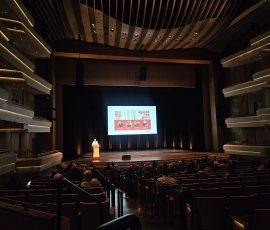
“Architecture itself is a profession of going against the grain.” At Design Forum 2026, Marlon Blackwell, Patricia Gruits, Ronald Rael, and Michael Reynolds reminded us that our theme for the weekend, Against the Grain, is in our DNA as architects. The lectures, discussion, and questions asked brought us closer to that origin story. The theme is abstract and difficult to define. The Design Forum committee referenced the dictionary, Shakespeare, and woodworking in our prompt to the speakers to gesture towards the idea. The hand of fate intervened, or a form of alchemy, because the abstraction of the term led each speaker towards a singular truth – that extraordinary practice comes from a deep love of the ordinary.
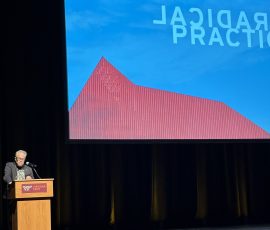
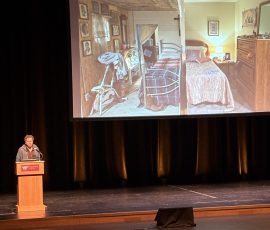
“Tension leads us to the task of strangeness”. Marlon Blackwell of Marlon Blackwell Architects began his lecture by reminding us that the Latin root of radical means rooted. Abstraction does not remove us from reality but instead allows us to take what the world is giving us and reinterpret it. The projects he showed ranged in use, location, and construction type but were united in their consistent point of view. Mr. Blackwell referred to architecture as a stream bed – by itself it has no value. His love of people is shown in the presence of porches on every project, a southern staple for gathering on hot days, which he calls a proscenium for life to happen. A sense of specificity in each building is present across every scale, from the custom automotive paint that allows beveled fins to glimmer like trees in sunlight to the Gee’s Bend quilts translated into a facade. In a world of standardization and efficiency through repetition, he reinforced the concept that architecture should be not just in a place but of a place and for a place.
“The problem with making sensible decisions is that so will everyone else.” Patricia Gruits also kicked us off with redefining a word central to her practice at MASS. Abundance is not the state of having more than you need, but rather having exactly enough. She showed work that proved that architecture can be an act of service towards the ideal of abundance for all. This includes the Earth: how can we design a world where people and the planet thrive? Each project she shared was extraordinary in form and proportion but the focus of her narrative was on the site. She sees the site as the source of the project, not a location. This source material is scaleless and infinite inspiration. Patricia inspired us to recontextualize ambition as a drive to find an extraordinary path for the betterment of all.
“Beauty and equity comes from the same act, the act of making.” Ronald Rael of Rael San Fratello showed a practice unbound by definition. His work exists along many spectrums, from ancient to modern, art to architecture, object to place. We saw homes for coral seeds and installations along the US Mexico border, adobe abodes and ovens for baking bread. His work shows a reverence for the existing that goes beyond inspiration. As Ronald explained his evolving process for building with 3d printed earth, it became clear that his imagination was as unmatched as his capacity for invention. How much richer would the world be if we all used the resources available to us? Ronald showed research that explored the realms of ancestral knowledge, craftsmanship, and activism. He challenged us to see beyond the constraints to something new.
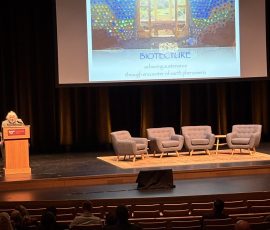
“Sometimes I think I’m the luckiest guy in the world because I want the things you don’t want. I want your garbage and I want your sewage.” Michael Reynolds of Earthship Biotecture shared a career that has worked to reframe architecture as a practice of designing buildings that grace the earth and support people through the reuse of refuse and recyclables in construction. The building is a machine, a spaceship, that contains everything a resident needs for life. So deeply grounded in site that the earthships are embedded in it, they create a self-sustaining ecosystem that keeps temperatures stable, reuses all water, and grows food. The core of the idea comes from the acceptance that trash is, at this point, a native building material on Earth. The resulting projects span the globe, adjusting the science to reflect each unique site, and prove that to find new opportunities for brilliance we need to reframe our perspective.
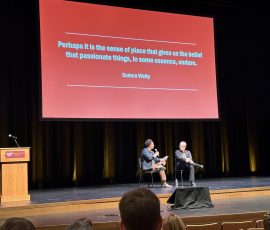
“We, as a discipline, are capable of designing the future we want.” At our closing panel, all four speakers reflected on the thoughts shared over the weekend. Although their practices vary in region, program and scale they were more united than different. Each speaker’s practice is deeply rooted in craft, specificity, context, material, empathy, and ecology. Design Forum feels like a gift, a rare opportunity to immerse ourselves in inspiration. I left Blacksburg after the final panel floating on air, excited and refreshed to get back to work, dig deeper, and look for opportunities beyond the expected. Thank you to everyone who joined us, we’ll see you in two years!