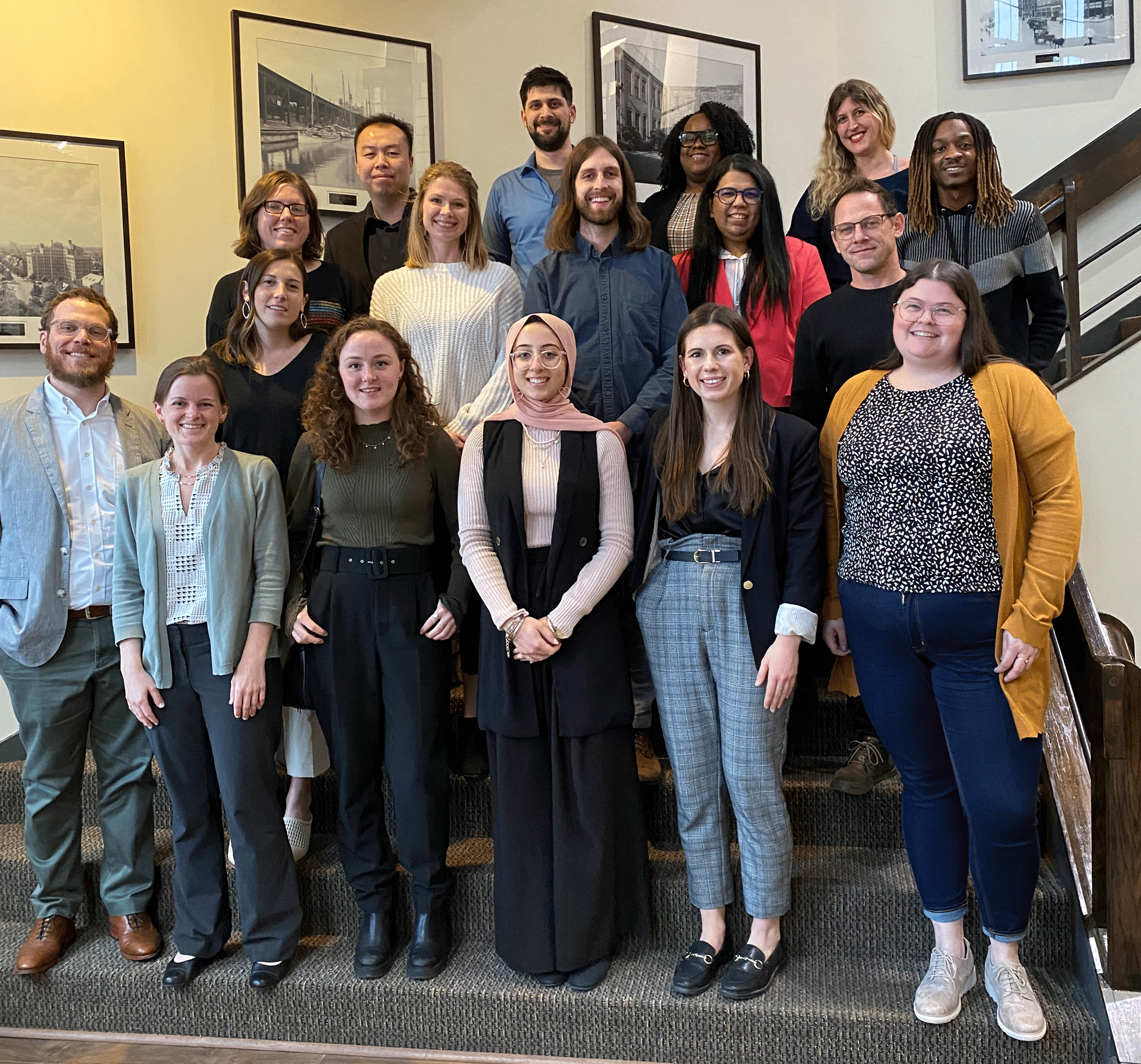
Meet the Emerging Leaders in Architecture class of 2023! This year’s class of 15 comprises architects and associates from around the state and students from Hampton University and the Washington-Alexandria Architecture Center. We will be traveling around the state throughout the year for our educational sessions and focusing on the Charlottesville area for this year’s class project. Would you like to support the class as they travel around the state? Contact Cathy Guske, cguske@aiava.org for more information.
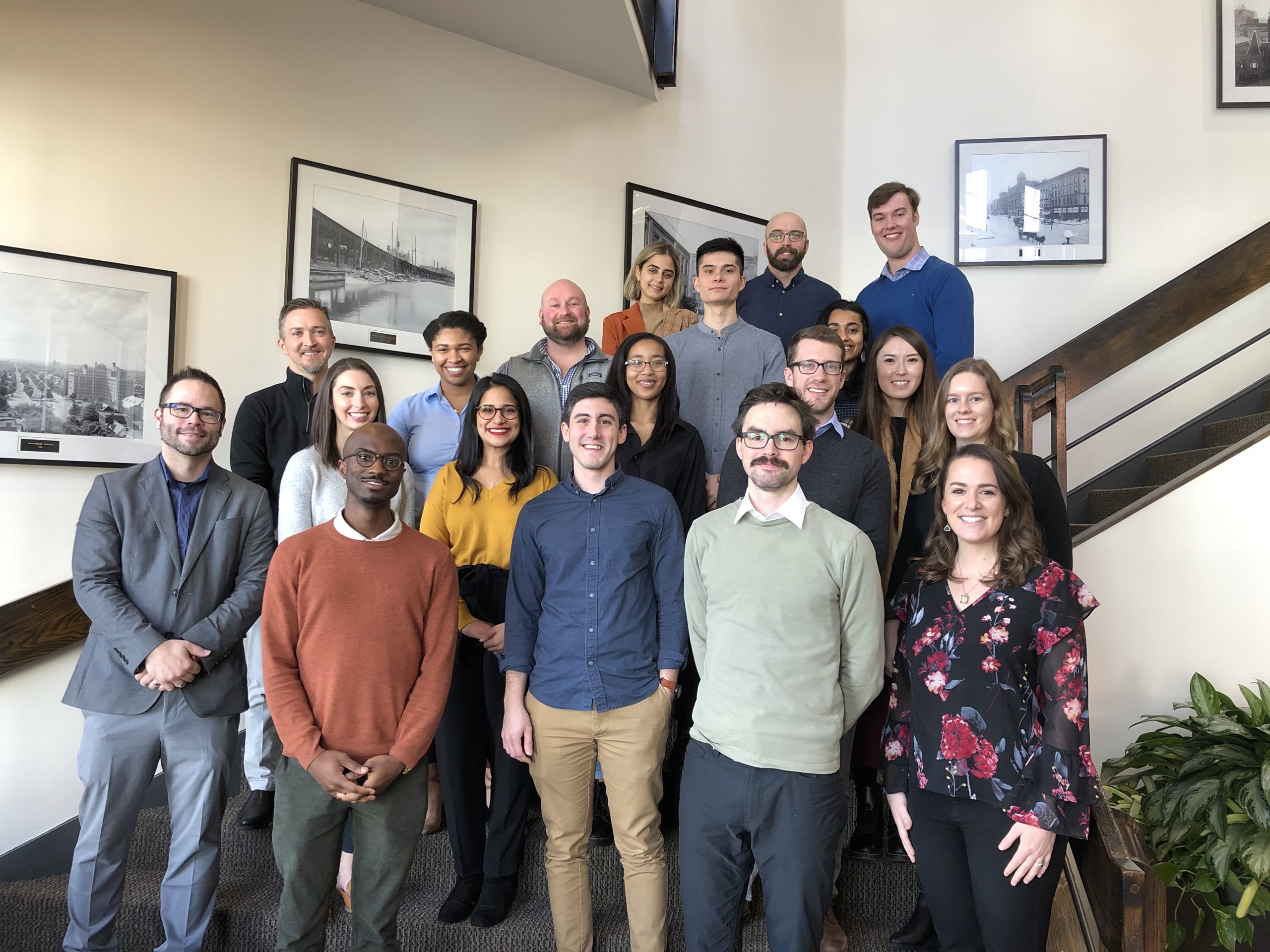
Bottom row: Noah Bolton (2023 Chair), Emily Baker, Ava Helm, Mira Abdalla, Anna Kniceley, Haley DeNardo (2023 Vice-Chair), Middle row: Lindsey Blum, Caitlin Morgan, Perry Hammond, Veena Shah, Adam Schultz. Top row: Cat Smith, Jason Lin, John Sturniolo, Briana Smith-Stiff, Kelsey White, Javius Richardson.
On Nov. 4, 2022 the members of the 2022 class of Emerging Leaders in Architecture presented their project presentation at Architecture Exchange East. The project was focused on solutions for the Belmont-Fallon community in Roanoke.
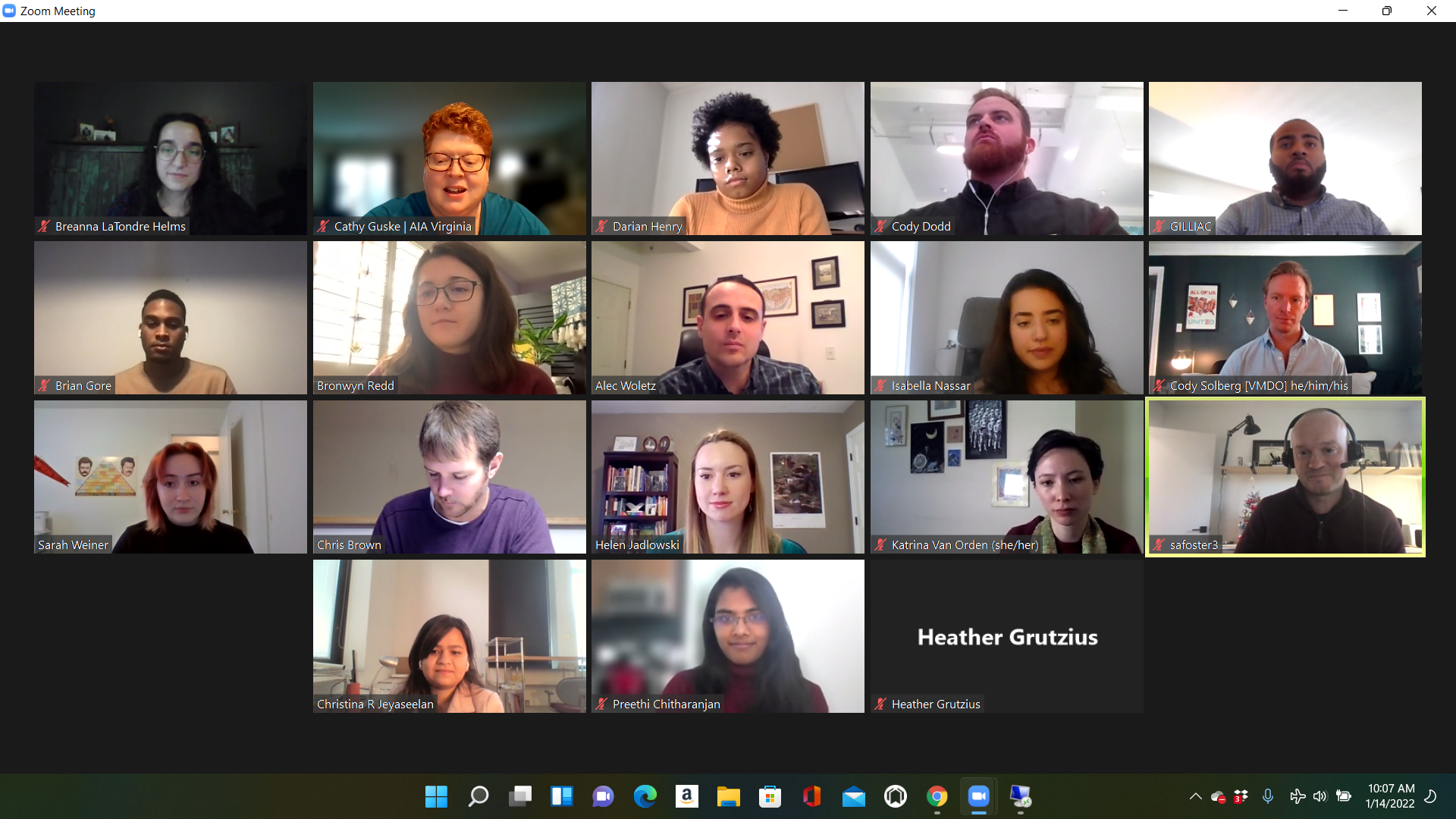
The 14th Emerging Leaders in Architecture (ELA) class started the year virtually last Friday with our first session and look forward to getting together in person in February in our project area of Roanoke, Virginia.
Shahadah Allah, AIAS, from Hampton University Christopher Brown, AIA, from Moseley Architects Preethi Chithranjan, Associate AIA, from AECOM Cody Dodd, Associate AIA, from Hanbury Steven Foster, AIA, from DBI Architects Cedric Gilliam, Associate AIA, from Jacobs Engineering Group Brian Gore, Associate AIA, from Quinn Evans Darian Henry, Associate AIA, from HBA Architecture Helen Jadlowski, AIA, from SFCS Christina Jeyaseelan, AIAS, from the Washington-Alexandria Architecture School (WAAC) Isabella Nassar, Associate AIA, from KGD Architecture Bronwyn Redd, Associate AIA, from Jacobs Engineering Group Cody Solberg, AIA, from VMDO Architects Katrina Van Orden, Associate AIA, from Hanbury Sarah Weiner, from Virginia Tech Alec Woletz, AIA, from Alloy Workshop Architecture and Construction
The 2022 leadership team is: Breanna LaTondre Helms, Associate AIA, ELA class of 2019, Chair Noah Bolton, AIA, ELA class of 2018, Vice-Chair Nick Cooper, AIA, Past Chair Chris Warren, AIA, ELA class of 2016, Emeritus Advisor
For more information about the ELA program or to help financially support this program, please contact Cathy Guske at AIA Virginia.
Donate online or text GIVE or DONATE to (202) 410-2150
If you’d only like to attend ELA @ ArchEx, register online. If you’d like to add other programs to your agenda, please use the registration form below.
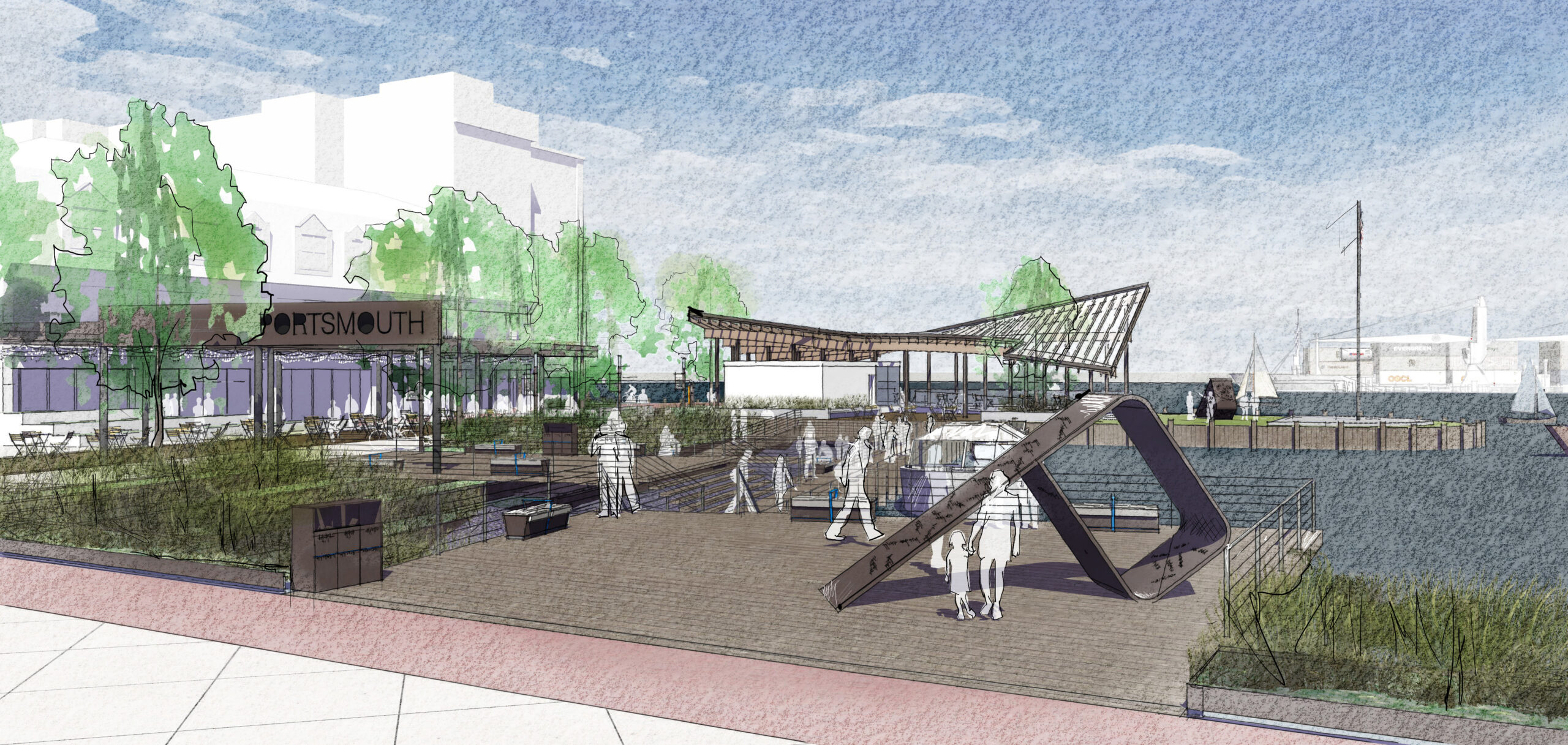
Our journey as the AIA Virginia ELA Class of 2020, was unprecedented for many reasons. Tasked with finding ways to transform the city Portsmouth and create an equitable, vibrant and a resilient downtown was a challenge from afar. With the social and political crises and the challenges that the Coronavirus pandemic brought to test how the in-person program functions, our team managed to match the scale of the hurdles with the amount of dedication and passion we all brought to the table. This program is designed to bring select designers and architects from across the state of Virginia to hone their skills as future leaders, give the the opportunity to widen networks, all while meeting with other designers from varying points in their careers. As a group, we gained much more than we initially expected, and we experienced much more than we could have ever imagined. As the class of 2020, (Ariana Arenius, Catherine C. Hendrick, Paris Casey, Kenneth Johnston, Christopher Cheng, Kristin L. Jones, Amanda Ferzoco, Mert Kansu, Michael Lawson, Zach Robinson, James Vidoni, Jacob Sherry, Gabriela Orizondo, Matt C. Stevison, Allison Powell, and Randa Malkawi) we are thankful for all the individuals and organizations who have made this program possible, and how it helped us improve as designers, architects, and citizens.
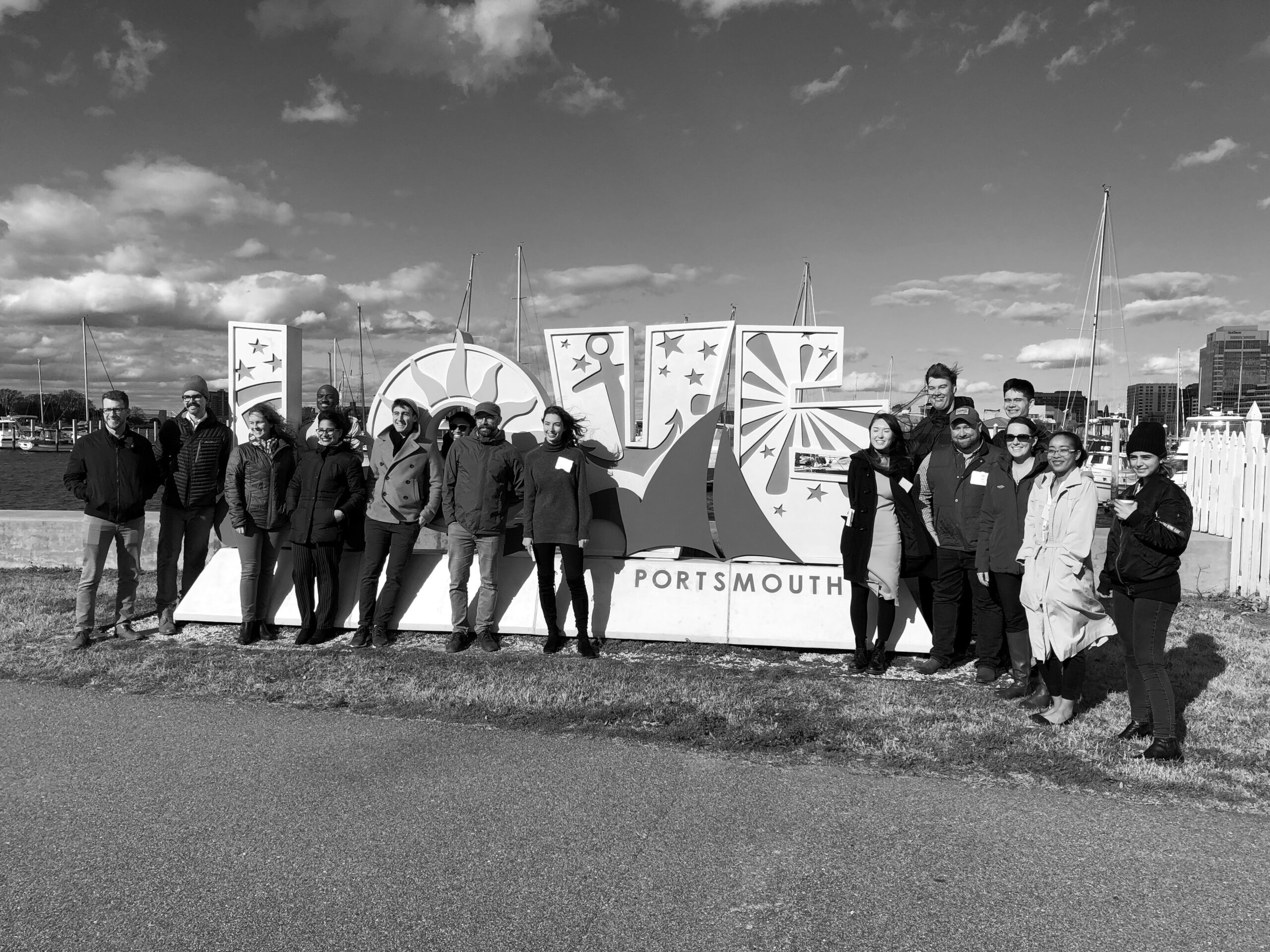
Emerging Leaders in Architecture – Class of 2020 in Portsmouth, Virginia.
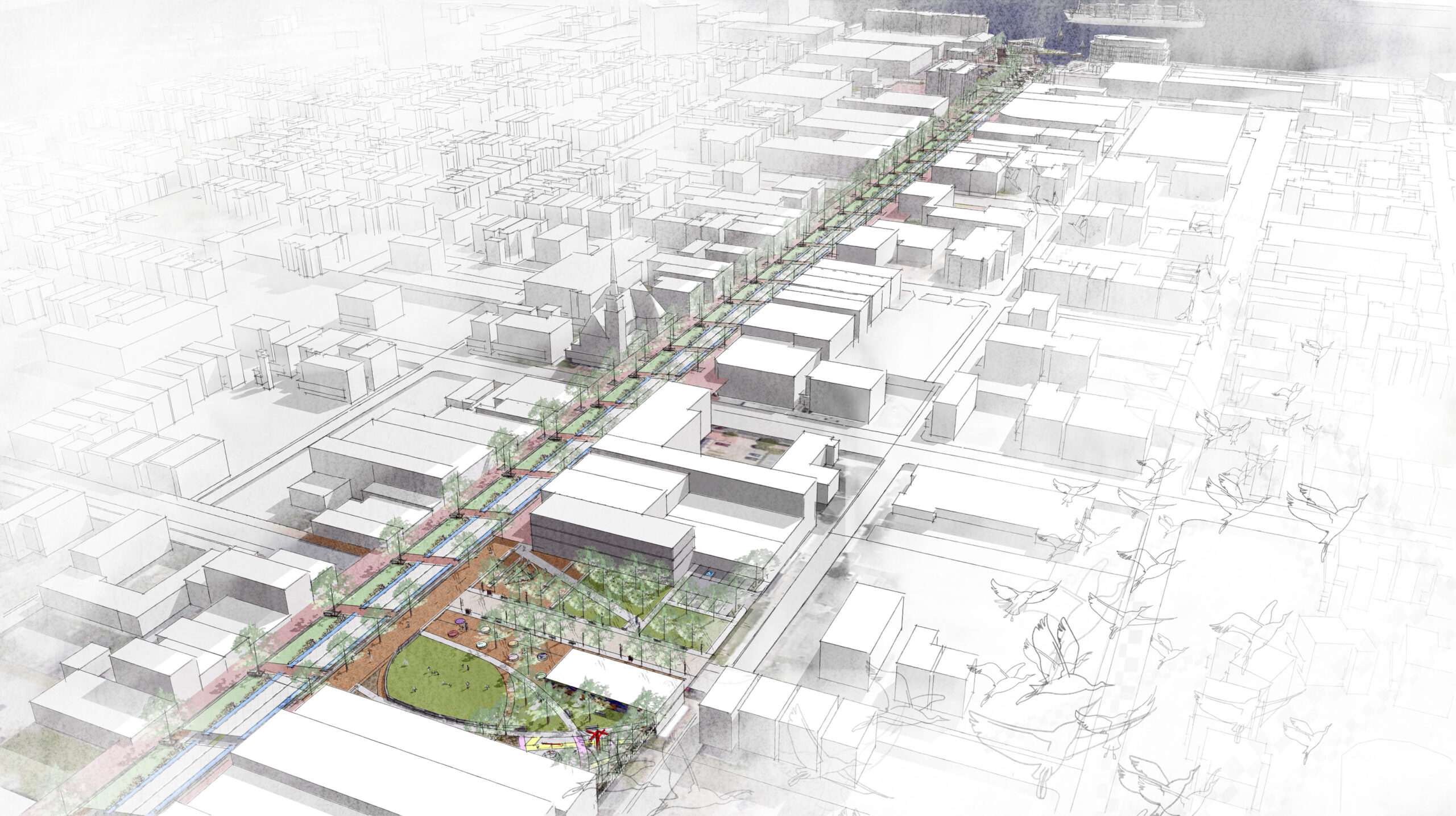
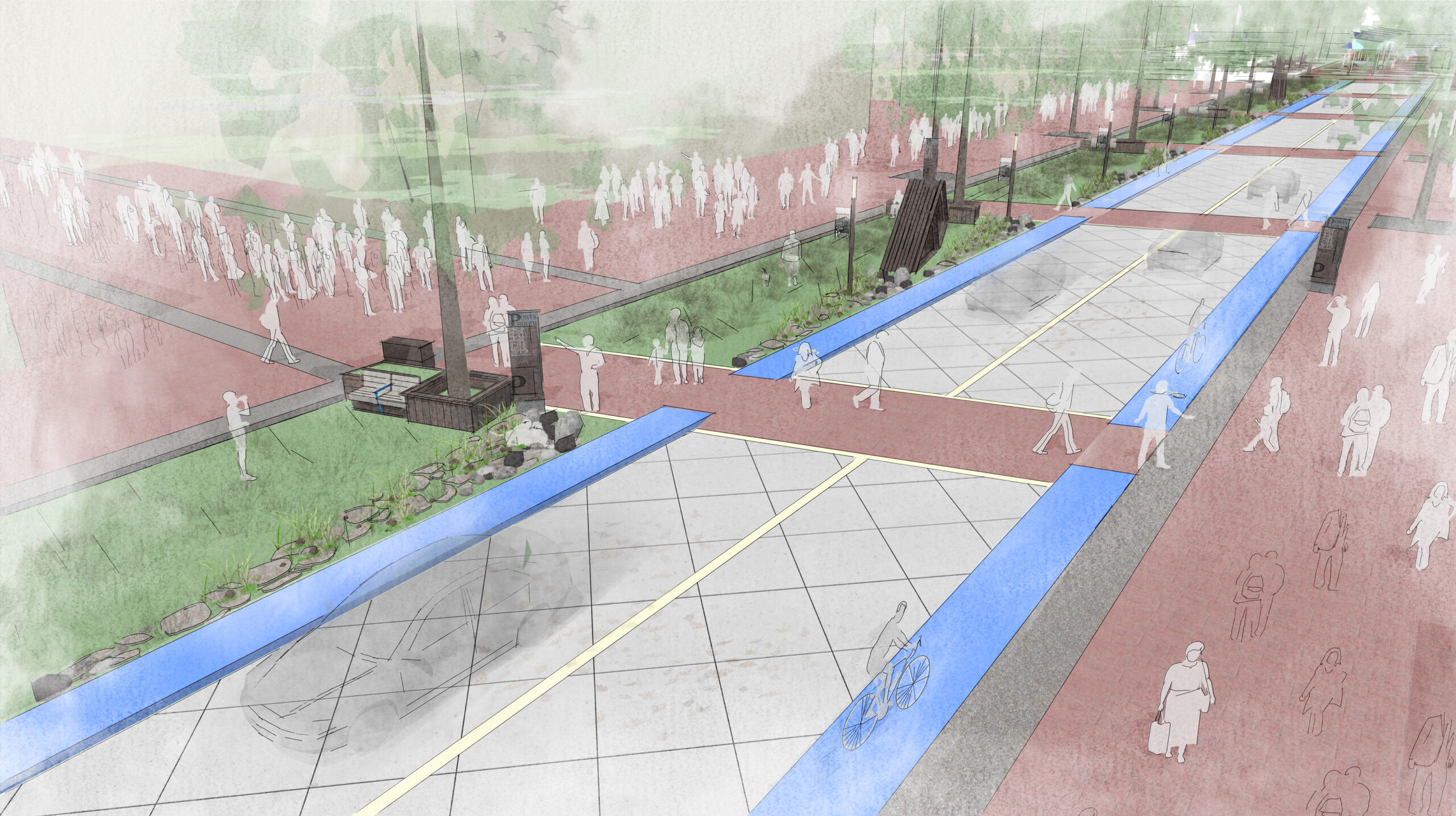
We started with bi-weekly tele-conferences for group and distributed tasks early in order to best coordinate. This made the transition to working from home and conducting the class fully virtually as smooth as possible. From the initial stages of the project research, we understood that any architectural intervention should reflect what the community desired. We did not aim to reform, transform, or rebrand the city without their involvement and accompaniment along the way. We believe what Portsmouth has in its local culture, history, and soul is invaluable. All we needed to do was make the right supporting moves as designers to reveal and compliment what was already present. Since we were not able to meet community members face-to-face, we utilized digital tools such as online surveys, social media advertisements, and digital flyers to reach out to the residents in survey form to get their opinions on what they feel was missing or could be improved in the city. With this survey data, site analyses, and research from past master planning efforts, we were able to pinpoint three main sites to focus our energy. We have selected two anchor sites, connected between with a re-envisioned street (High Street). These sites would help attract residents as well as visitors to the city, bringing a pedestrian friendly atmosphere to boost the commerce along High Street. This in turn could help kickstart a chain of development improvements throughout Portsmouth.
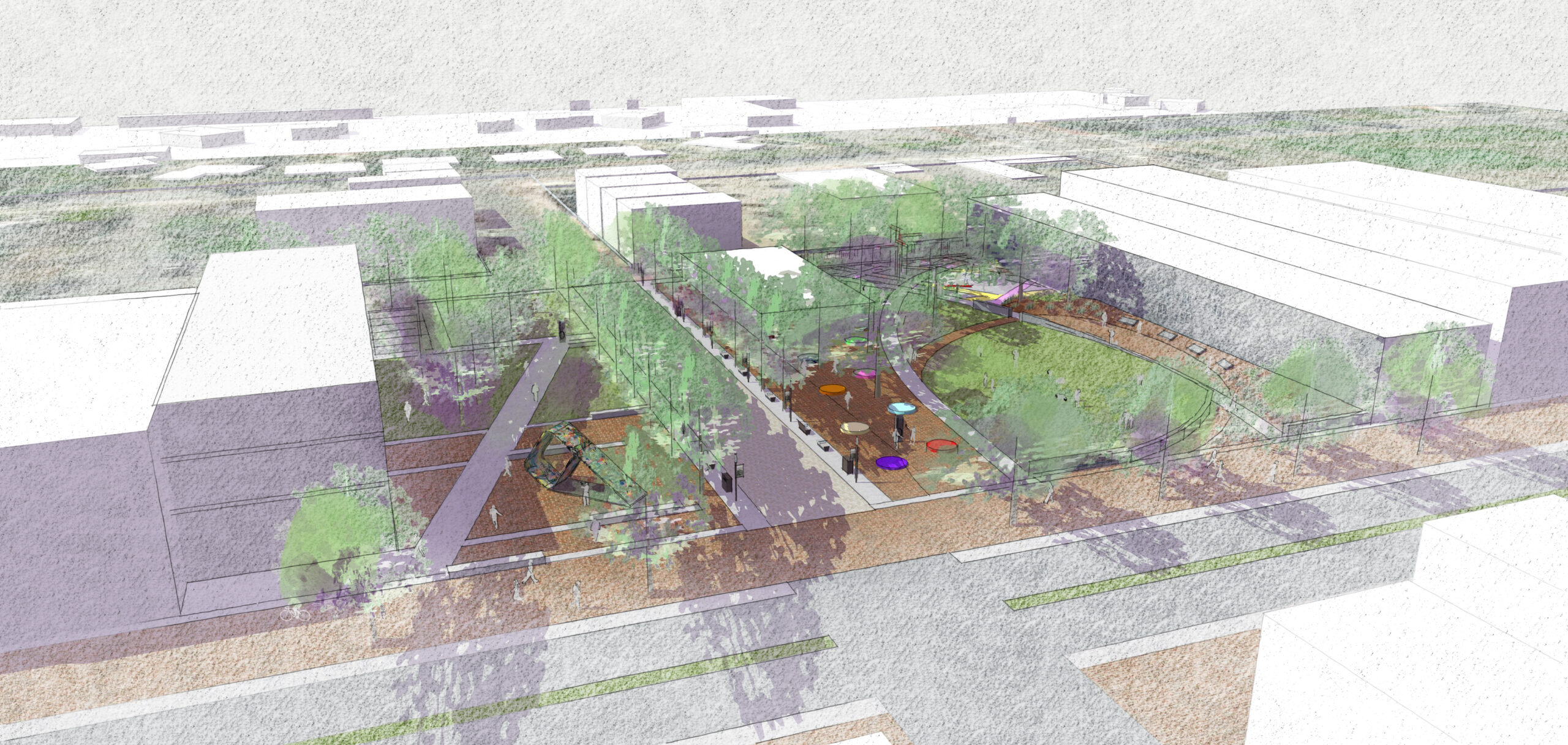
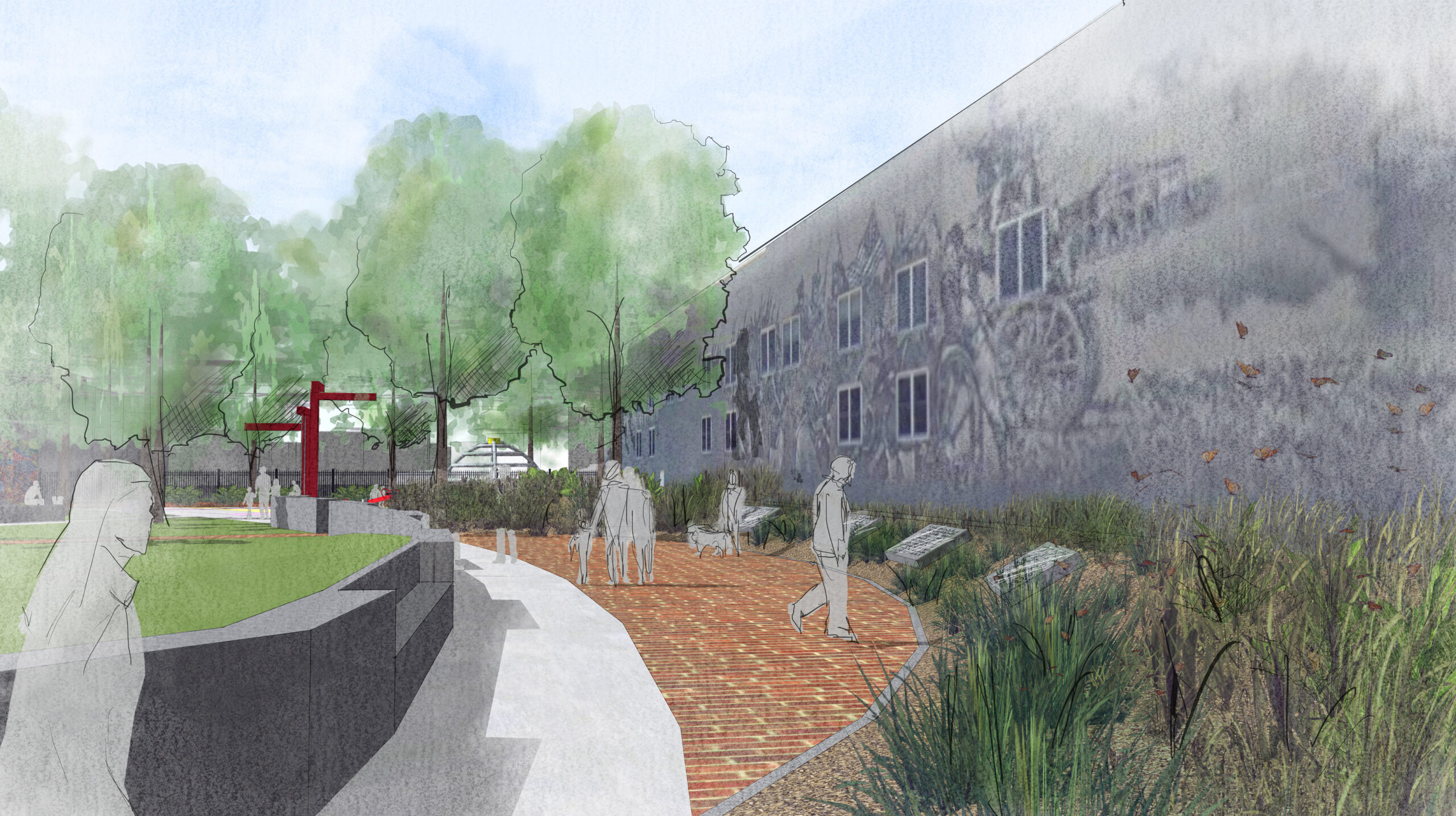
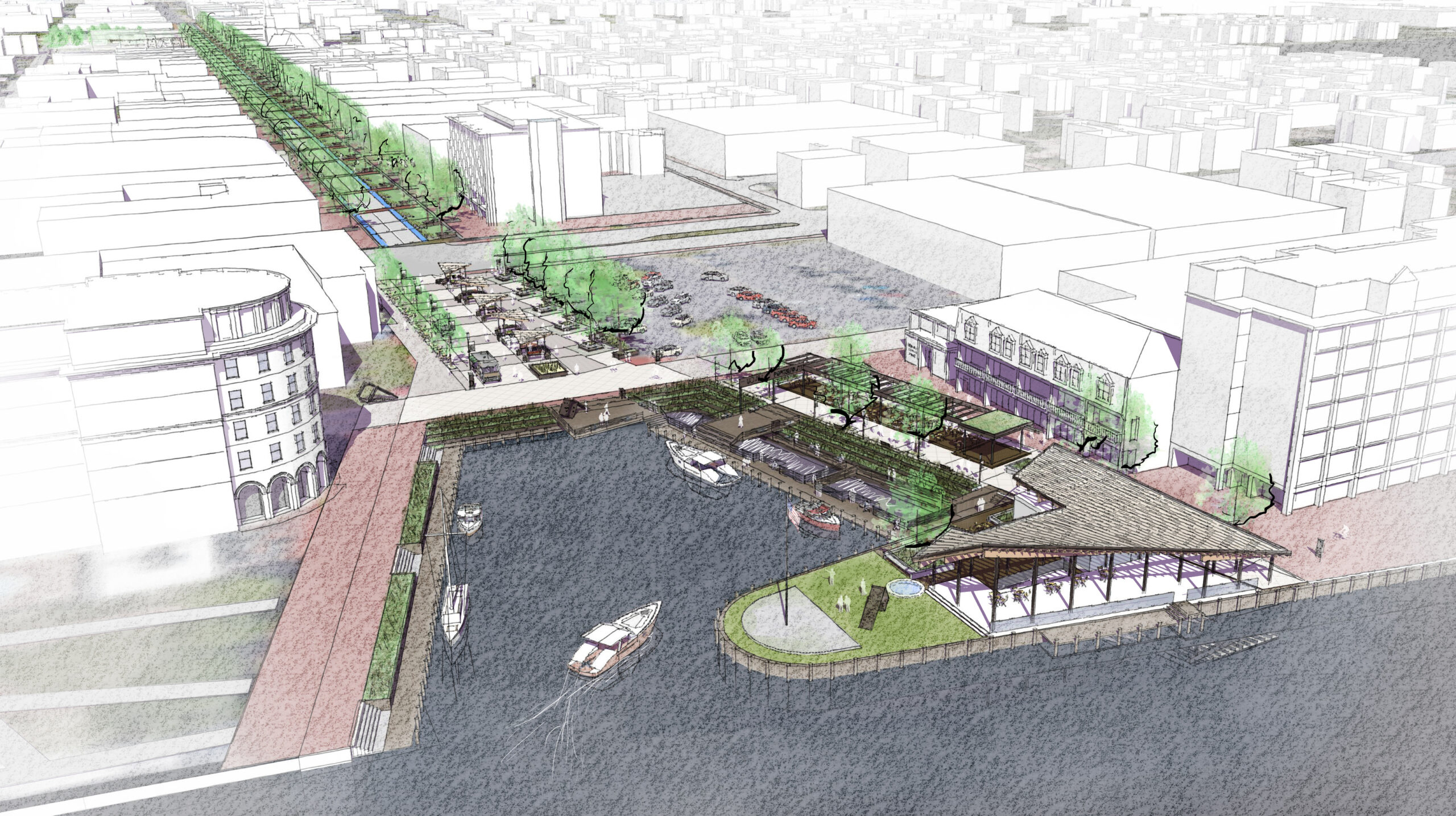
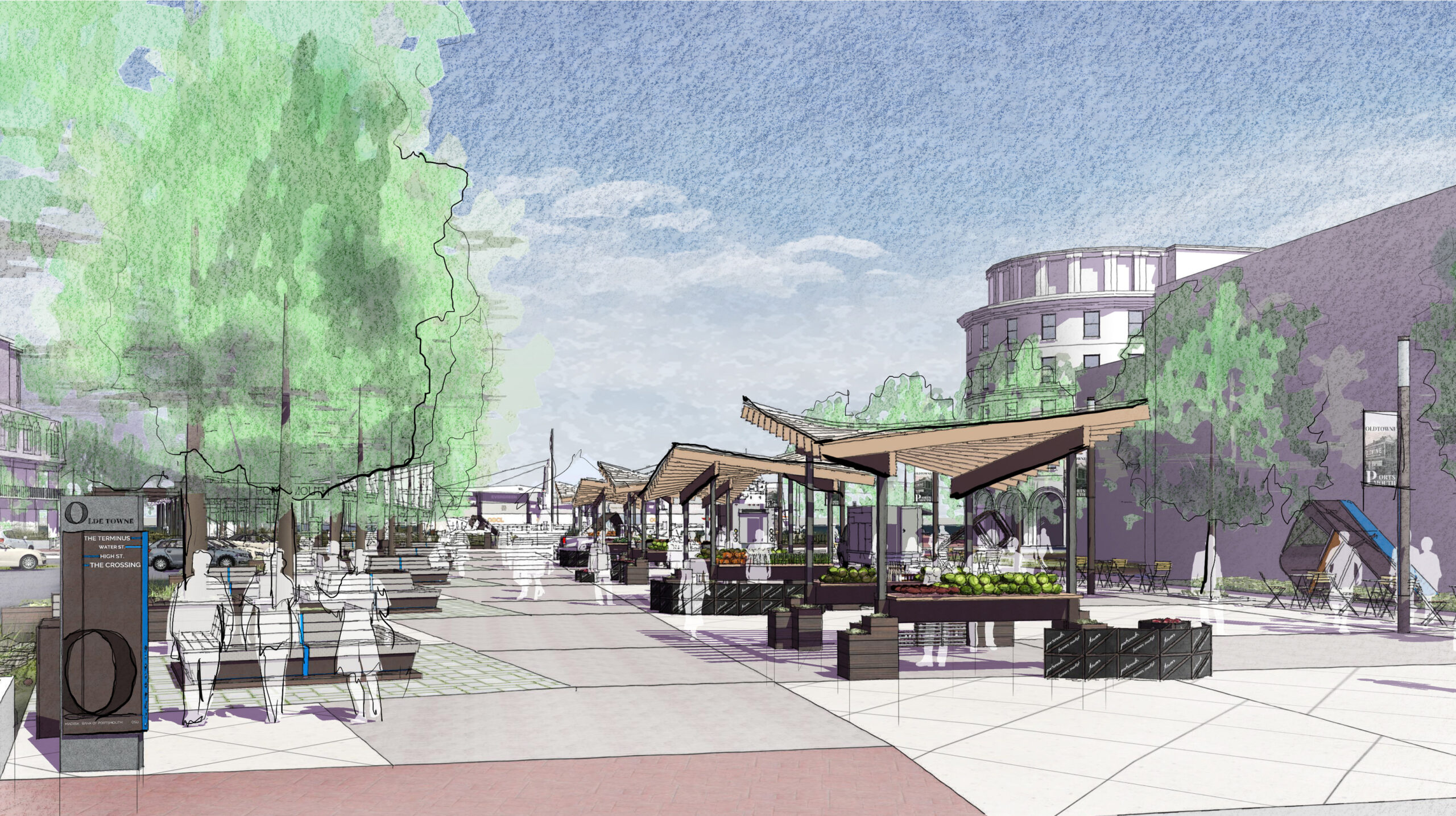
The Green Street Crossing site, located at the intersection of High and Green Streets, was an abandoned site of a former Church, since burnt down. Housing a large building mural of the Battle of Craney Island, this site has been envisioned as a park that includes green spaces, resting areas, a playground, and a community center. On redesigned High Street, more room for green space gives way to slowing traffic with pavement interventions and a more pedestrian and bike friendly setting. The High Street Landing site sits at the end of High Street at the waterfront. This development, already partially constructed in downtown Portsmouth, has been a commendable success, however the connection to the business corridor is lacking. An inlet housing music events and a dock for small boats is improves into an urban park with an educational and bio-diverse terrace containing oyster beds. This move brings back the local biome to the water’s edge, helping with stormwater runoff. An improved dock and a new pavilion building on the edge of the waterfront brings a dynamic stronghold to the coastline view from across the river. As the pedestrian walks inland towards the High Street corridor, the street is pedestrian oriented, but still allowing one way traffic. This area is flexible, with Farmer’s Market stalls in place for public use except during market hours.
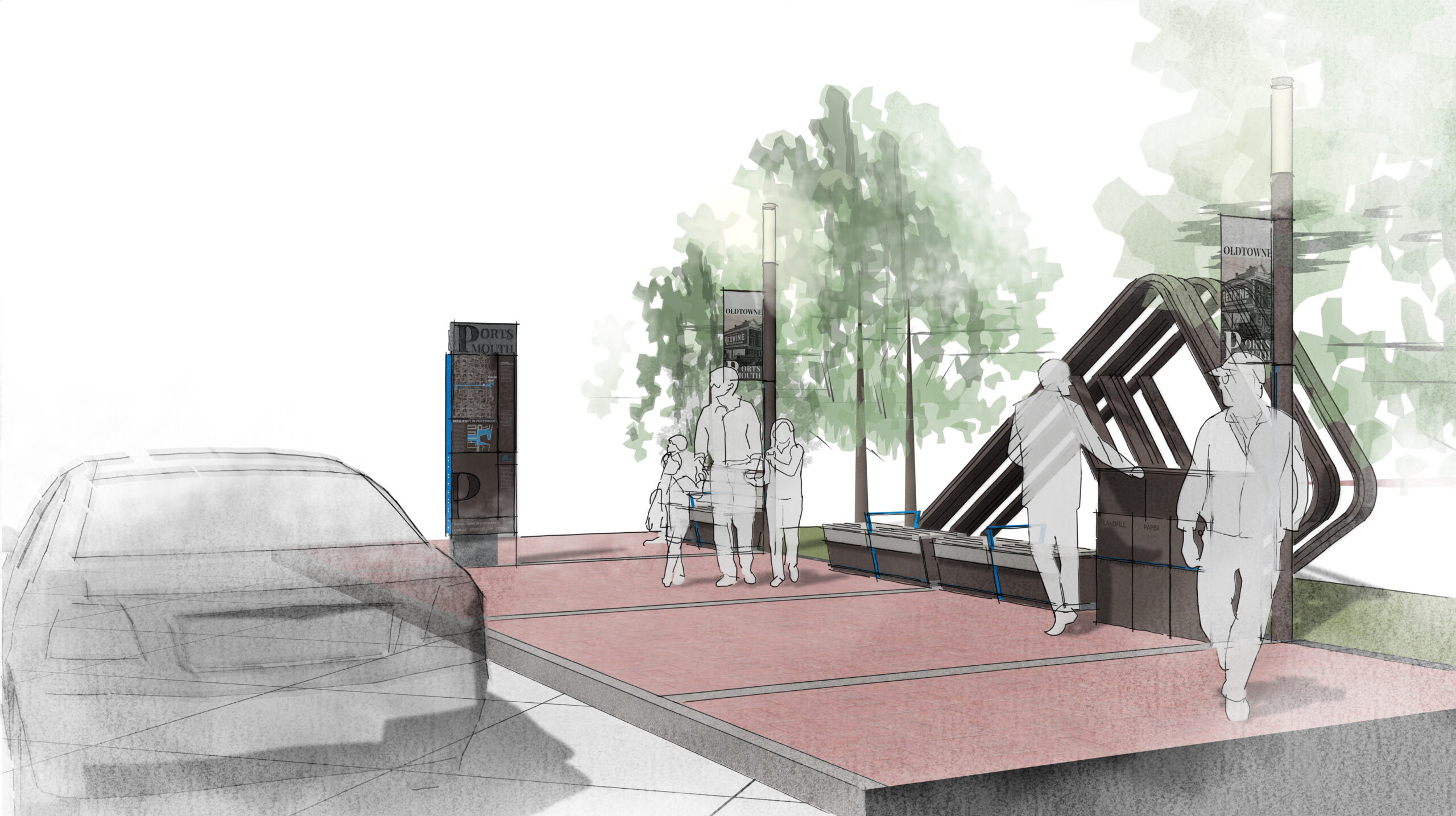
Efforts were organized into parcels and concepts that can be individually phased to be more realistically funded and built. The intention was to have a multi-scale approach to our design. As a part of this effort, we wanted to zoom in to the human scale, the daily life of a person that is walking or driving around Portsmouth. With Wayfinding & Signage studies, we developed a package that included a vision of what wayfinding objects, street furniture, signage, and city art could look like, in order to reinforce the Portsmouth brand. As this design could spread farther away from the core downtown, we looked into redesigning the look of the tunnels, to instill a strong impression of the city for those traveling through.
With the art installation, named “The P” (as in Portsmouth,) iterations of a steel P shaped object have been created that could exist in different locations throughout the city. Made from oxidized steel, a familiar material to this historic naval city, we imagined this object could be a way for the community to come together, gather their expertise in artisans, and build a branded object which would be placed along the streets that are walked everyday.
Our work has been extensive, but we could not be happier with the results of this challenge. We have worked passionately to present something that could help improve Portsmouth. We gathered our work for this year into a book and gave multiple presentations to the community members, local organizations, and city officials. Months after our official graduation from the program, we are still in touch with the City, and working hard as a group to keep the conversation going to get construction started. We love the excitement that has resonated with the locals who have heard about the work. Our dream is that the city benefits, and in some way the work we have done can catalyze action among officials and developers to help realize the great potential that the city contains already.
AIA Virginia announces the call for applications for the 2021 class of Emerging Leaders in Architecture (ELA): An Honors Academy of AIA Virginia.
The application and more information is available here>> The application deadline is Nov. 6, 2020.
ELA is an intensive program of educational sessions structured around presentations, discussions, team exploration, analysis, consensus-building, collaboration, and case study activities undertaken over the course of a year by a small cadre of participants selected for their potential to be outstanding contributors to the profession and the community. Facilitators and mentors who are established leaders in the building, finance, non-profit, development, university, legal, consulting, and design professions and in the community at large develop and deliver the sessions, designed to provide participants with advanced knowledge and skills related to specific areas of leadership and practice.
The program consists of monthly, day-long seminars, work sessions, or class project presentations, culminating at a presentation at Architecture Exchange East in November.
The seminars are interactive, drawing on real examples and actively involving participants. They rotate among sites in Roanoke, Charlottesville, Richmond, Alexandria, and Norfolk in conjunction with the firms, schools, and the local AIA component in each area.
The class project for 2021 will be in Richmond, so many sessions and the project workdays will be located in the Richmond area.
How to Apply The committee seeks applicants from three categories:
Component Nominees: Each of the five AIA Virginia local component Boards may nominate one or more individuals for admission to the program. One participant will be selected from each component for a total of five. If interested, please contact your local AIA chapter representative. Each chapter sets its own deadline and application requirements for these positions.
Student Nominees: Each Virginia Architecture School (UVA, VT, Hampton, and WAAC) may nominate one or more students for admission to the program. One participant will be selected from each school for a total of four. If interested, contact your department Chair/Dean.
Open Applications: Applicants may apply on their own or be nominated by someone else. Seven participants will be selected from among these applicants.
The application and more information is available here>> The application deadline is Nov. 6, 2020.
If you have any questions, please contact Cathy Guske, Member Services Director, cguske@aiava.org